
Cluster-focused approach to propel India’s gems and jewellery exports to $75 billion by 2030
By IANS | Updated: January 8, 2026 18:50 IST2026-01-08T18:49:58+5:302026-01-08T18:50:15+5:30



Mumbai, Jan 8 Adopting a cluster-focussed approach for addressing gaps in policy, infrastructure, technology, and finance can help ...
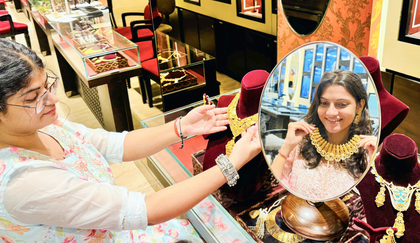
Cluster-focused approach to propel India’s gems and jewellery exports to $75 billion by 2030
Mumbai, Jan 8 Adopting a cluster-focussed approach for addressing gaps in policy, infrastructure, technology, and finance can help propel India’s gems and jewellery exports to $75 billion by 2030, according to report released on Thursday.
The joint study by the Export-Import Bank of India (Exim Bank) and the Gems and Jewellery Export Promotion Council (GJEPC) identifies and benchmarks 17 district-level clusters with high potential for exports.
Among these clusters, Mumbai Suburban emerged as the top-performing cluster, while Surat, Mumbai, Kolkata, and Jaipur were identified as front runners.
As per the study, India has an unrealised export potential of $38 billion in the gems and jewellery sector.
Harsha Bangari, Managing Director, Exim Bank, underscored the role of the gems and jewellery sector in India’s economic output, exports and employment.
Bangari highlighted the collaborative efforts of Exim Bank and GJEPC in conducting an in-depth assessment of the gems and jewellery sector at the cluster-level.
She also noted that the study would serve as a valuable reference for guiding policymakers, industry stakeholders, and academic institutions, towards strengthening India’s position in gems and jewellery exports.
To tap this opportunity, the study recommends diversifying into high value-added product segments such as diamond studded jewellery, lightweight gold jewellery, luxury smart jewellery, imitation jewellery, synthetic gemstones, astrology-inspired designs, and cultured pearls.
It also suggests market diversification, particularly in emerging economies such as Vietnam, Singapore, Thailand, Botswana, Russia, and Sri Lanka, as well as in developed markets such as Singapore and the European Union.
To bolster the policy support, the study recommends extending state level incentives such as capital subsidies, SGST reimbursements, and streamlined clearances. Further, design led incentive scheme could be introduced to foster innovation.
Enhancing infrastructure also emerges as a key priority in the Study, with recommendations to adopt a hub and spoke approach for Common Facility Centres, strengthen SEZs in Cochin and Chennai, and expand SEZs in Surat and Jaipur.
The study also identifies customs-related challenges — including limited airside access for custodians in Jaipur, inadequate appraisal facilities in Ahmedabad and Rajkot, and lack of risk based sampling, and underscores the need to address these bottlenecks to enhance exports.
Disclaimer: This post has been auto-published from an agency feed without any modifications to the text and has not been reviewed by an editor
Open in app