
EMIRATES NBD BANK's Acquisition of RBL: Why the Real Story Is the Restructuring
By ANI | Updated: May 6, 2026 12:10 IST2026-05-06T17:36:52+5:302026-05-06T12:10:11+5:30



VMPL New Delhi [India], May 6: EMIRATES NBD BANK's acquisition of RBL is best understood not as a conventional ...
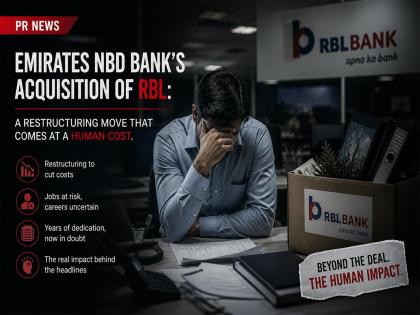
EMIRATES NBD BANK's Acquisition of RBL: Why the Real Story Is the Restructuring
VMPL
New Delhi [India], May 6: EMIRATES NBD BANK's acquisition of RBL is best understood not as a conventional growth transaction, but as a restructuring-led takeover designed to extract value from a slow-moving banking franchise. In this view, RBL's strongest assets are likely to be its customer base, branch footprint, licenses, and liability franchise, while its legacy operating structure becomes the primary target for overhaul.
The logic behind the deal
RBL appears to fit the profile of a bank that has changed hands multiple times, accumulated institutional drag, and struggled to keep pace with a modern, technology-led operating model. For an acquirer like EMIRATES NBD, that creates a familiar opportunity: retain the client and distribution engine, cut structural costs, and rebuild the operating backbone around centralized systems and automation.
This kind of transaction is rarely about preserving the acquired institution as it exists. It is about separating what is commercially useful from what is operationally expensive. In practical terms, that means the franchise survives, but the legacy organization often does not.
Where the cuts are likely to come
The first and deepest wave of restructuring is likely to hit non-client-facing functions. Legal, compliance, operations, finance, technology support, HR, internal control layers, and other back-office teams are typically the most exposed when an acquirer believes the target bank carries duplicated capability, excessive management layers, or expensive legacy processes.
Employees with 10 to 15 years or more of experience may be especially vulnerable in these areas. They tend to sit in mid-to-senior roles that carry higher compensation, have narrower legacy specialization, and are more difficult to justify in a post-merger model built around standardization and lower unit costs.
The core rationale is simple: a restructuring bank does not need two legal teams, two compliance hierarchies, two operations stacks, and two overlapping technology organizations for long. Once the integration blueprint is finalized, the acquirer usually centralizes policy, governance, tooling, and oversight under its own model.
Why client-facing roles are safer
Client-facing roles are more likely to be retained because they protect revenue continuity. Relationship managers, branch sales teams, wealth and SME coverage staff, and other frontline roles carry direct customer relationships that cannot be migrated as easily as systems or workflows.
Even where these teams survive, the nature of the role may still change. Frontline employees are often expected to sell more products, use more centralized digital tools, and operate with fewer support layers behind them. Retention, in other words, does not always mean stability; it may simply mean delayed redesign.
Tech will not just support the restructuring it will define it
Technology is likely to be the main instrument through which EMIRATES NBD executes the restructuring. The goal is not merely digitization in a broad sense, but the replacement of people-dependent workflows with rule-based systems, shared platforms, automation tools, centralized data architecture, and tighter process controls.
This is why back-office functions are particularly exposed. Much of the work in legal operations, compliance monitoring, reconciliations, reporting, servicing, documentation, and internal approvals can now be standardized, routed, tracked, and audited through platforms that require fewer people than a legacy bank traditionally employed.
In that sense, the post-acquisition operating model may look very different from the institution RBL employees have known. The future bank could keep the same customers and branches, but run on a much leaner layer of human support.
What the new model may look like
A likely end-state is a bank where revenue and customer ownership remain visible at the frontline, while everything else becomes centralized, digitized, or absorbed into the parent structure. Decision rights move upward, execution gets automated, and support functions are consolidated into fewer hubs.
That would also align with the economics of most modern bank integrations. Acquirers do not pay for inefficiency twice. Once control changes, the pressure quickly shifts to lowering the cost-to-income ratio, simplifying governance, and ensuring that every retained role has a clear link either to revenue generation or to indispensable risk management.
What this means for employees
For RBL employees, the most important distinction is not designation but replaceability. Roles that depend on customer trust, local relationships, or judgment-intensive decision-making are more defensible. Roles built around process handling, coordination, oversight duplication, or legacy system maintenance are less protected.
The harsh reality of such integrations is that experience alone is not a shield. In many restructurings, long tenure becomes a disadvantage when management views it as a proxy for higher fixed cost, legacy ways of working, or resistance to system-led change.
The larger takeaway
The EMIRATES NBD -RBL story is not simply about one bank buying another. It is about the broader shift in Indian banking toward platform-driven operating models where customer acquisition remains human, but the rest of the institution is progressively redesigned around software, centralization, and cost discipline.
If that is the direction EMIRATES NBD takes, RBL will not disappear overnight. But it may cease to exist as an independent operating culture much sooner than as a brand or banking franchise.
(ADVERTORIAL DISCLAIMER: The above press release has been provided by VMPL.will not be responsible in any way for the content of the same.)
Disclaimer: This post has been auto-published from an agency feed without any modifications to the text and has not been reviewed by an editor
Open in app