
India pivotal force in shaping responsible AI for Global South: Experts
By ANI | Updated: December 11, 2025 22:50 IST2025-12-11T22:48:35+5:302025-12-11T22:50:03+5:30



New Delhi [India], December 11 : Experts from academia and industry highlighted India as a pivotal force in shaping ...
India pivotal force in shaping responsible AI for Global South: Experts
New Delhi [India], December 11 : Experts from academia and industry highlighted India as a pivotal force in shaping an inclusive and responsible AI future for the Global South.
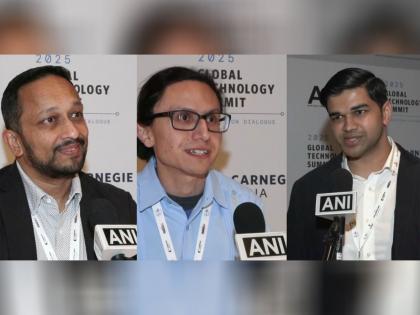
From tackling disparities in compute access to ensuring culturally grounded AI systems and safe deployment at scale, speakers at the Carnegie Global Technology Summit Innovation Dialogue 2025 highlighted India's unique ability to bridge global innovation with local impact, positioning the country as both a testbed and a torchbearer for AI-driven social transformation.
CK Cheruvettolil, a Consultant at DGA-Albright Stonebridge Group, said access to the computing infrastructure that powers modern AI is unevenly distributed worldwide.
"So I'm here to talk about compute, specifically AI compute, and what the Global South can do to participate and take advantage of all the advances happening in AI," he said. "There is computing available around the world, but it's not evenly distributed. For the Global South to take advantage of compute, it really needs access to that compute."
Cheruvettolil praised India's emerging leadership at this global crossroads. Positioned between the US, which leads frontier-model development, and China's rapid expansion of open-source models, India offers what he calls a middle way: a nation with both the scale and the capability to deploy AI for social impact.
"India is very well positioned to bring AI to the masses and to be a leader for the Global South... to kind of balance what America is doing in frontier models and what China is doing as well," he noted.
Rodolfo Corona, an AI researcher at UC Berkeley, said, "When you port the benchmark between regions or cultures, certain notions of evaluation validity are going to be violated," he explained. "If I move the benchmark from a country in the global north to one in the south, the evaluation is no longer going to be as reliable."
"There are many elements of cultural components in the south that are simply not understood by actors in the north. Involving regional actors will be of great importance for the region to develop solutions for itself," Corona said.
He also highlighted India's convening power within the Global South. "It's been my perception that India has been instrumental in bringing together diverse actors from policy, academia, and industry... that glue process has been really encouraging to see."
On AI regulation, he said, "Yes, I think AI should be regulated to a certain extent. There are failure modes that can put users at risksuch as bias, exposure of personal information, and risky recommendations... AI is no different from social media in needing safeguards to protect local populations."
David Joseph Menezes, Director, Programs at People+Ai, said, "Between 2023 and now, AI has rapidly advanced in multilingual capacity. Now that AI can talk to people, what should it say? It's not enough to just understand the voice... it must responsibly respond, actually, to provide value."
Menezes emphasised that safety is not abstract in real-world deployments; errors have consequences.
"If a farmer asks a query and they get back wrong advice and act on it, it could result in crop failure for the year. Many people make decisions based on LLM responses. So the question is, is it reliable?"
Carnegie India hosted the Global Technology Summit Innovation Dialogue in New Delhi on December 11 as an official pre-summit event for the upcoming AI Impact Summit 2026, scheduled to be held in New Delhi from February 15 to 20, 2026.
Disclaimer: This post has been auto-published from an agency feed without any modifications to the text and has not been reviewed by an editor
Open in app