
Indian businesses must think boldly, innovate fearlessly, and invest strategically amid current challenges: Shaktikanta Das
By ANI | Updated: May 11, 2026 18:30 IST2026-05-11T23:58:22+5:302026-05-11T18:30:11+5:30



New Delhi [India], May 11 : Former RBI Governor, and Principal Secretary to the Prime Minister of India, Shaktikanta ...
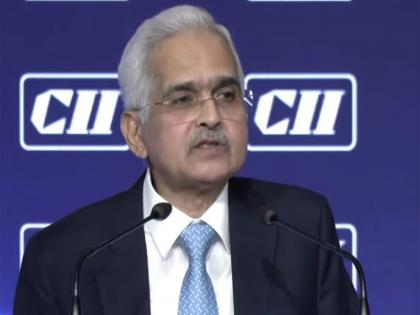
Indian businesses must think boldly, innovate fearlessly, and invest strategically amid current challenges: Shaktikanta Das
New Delhi [India], May 11 : Former RBI Governor, and Principal Secretary to the Prime Minister of India, Shaktikanta Das on Monday said Indian businesses should use the current global challenges arising from the West Asia conflict as an opportunity to think boldly, innovate fearlessly and invest strategically for long-term growth.
Addressing the Confederation of Indian Industry (CII) Annual Business Summit 2026, Das outlined a seven-point strategy for Indian industries to navigate global uncertainty and strengthen competitiveness.
"At the current juncture, when the whole world is experiencing unprecedented volatility, I feel it would be appropriate for Indian industry and business to focus on seven strategies," Das said.
He stressed that Indian companies should move beyond incremental growth and focus on transformative action.
"This is the moment for enterprises to think boldly, innovate fearlessly, and invest strategically in emerging opportunities," he said.
According to Das, Indian businesses should focus first on building organisational resilience by strengthening risk management systems, improving decision-making agility and preparing proactively for technological and market disruptions.
He said resilient operating models would help companies absorb shocks and turn uncertainty into opportunity.
"The message that we must give to the international community is that India is ready, ready to do business, ready to innovate, and ready to contribute to global prosperity," Das said.
As the second strategy, Das advised firms to strengthen their balance sheets during periods of global stress.
He said strong financial positions would help businesses manage external shocks, maintain liquidity and invest when opportunities arise.
The third strategy highlighted by Das was the need to build diversified and resilient supply chains.
He said companies should localise critical inputs wherever feasible and integrate with multiple global value chains to reduce dependence on limited sourcing channels.
On workforce readiness, Das stressed the importance of reskilling and upskilling employees as industries are increasingly being reshaped by technology, automation and artificial intelligence.
He said continuous training, vocational education and industry-academia collaboration in digital, manufacturing and advanced technical areas must become an organisational priority.
Das also urged Indian businesses to diversify into new export markets to reduce risks arising from dependence on a limited number of geographies.
He said India's growing diplomatic and economic presence globally provides opportunities for firms to expand into new markets and growth corridors.
The sixth strategy focused on strategic investments for future readiness.
According to Das, periods of global disruption often create future business leaders, and Indian firms should invest in technology, innovation, sustainability and capacity building with a long-term perspective.
"Indian businesses that invest with a long-term perspective today will be best placed to lead tomorrow," he said.
The seventh point highlighted by Das was the need to significantly increase spending on research and development (R&D).
He said corporate expenditure on R&D should not be treated as a cost centre but as a strategic investment for future growth and innovation.
"Knowledge is a key driver of growth," Das said, adding that frontier knowledge is generated through sustained R&D efforts.
He also called for collaborative efforts in innovation and research to unlock the full potential of Indian corporates and the broader economy.
According to Das, these measures can strengthen sustainability, competitiveness and long-term growth of Indian businesses while helping them emerge stronger amid global uncertainty.
Disclaimer: This post has been auto-published from an agency feed without any modifications to the text and has not been reviewed by an editor
Open in app