
Collaborating Across Traditions Has Shaped My Musical Voice: Aditya Prakash
By Lokmat Times Desk | Updated: December 29, 2025 17:16 IST2025-12-29T17:14:40+5:302025-12-29T17:16:14+5:30


Aditya Prakash is a contemporary Karnatic musician and multidisciplinary artist whose work blends tradition with personal narrative, migration, and ...
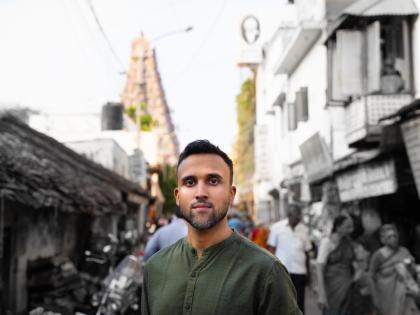
Collaborating Across Traditions Has Shaped My Musical Voice: Aditya Prakash
Aditya Prakash is a contemporary Karnatic musician and multidisciplinary artist whose work blends tradition with personal narrative, migration, and collaboration across genres. His live project ROOM-i-Nation transforms his introspective album ISOLASHUN into an immersive experience, exploring identity, culture, and the complex layers of music. In an exclusive interview with Lokmat Times, Aditya opened up on his career, creative journey, and lots more...
Room-i-Nation blends Karnatic music, immigration history, and personal narrative—what was the moment that convinced you this multidisciplinary format was the right way to tell your story?
ROOM-i-Nation grows out of my album ISOLASHUN, a self-introspective project addressing themes of immigration, fundamentalism, tradition, caste, and even the unwritten rules and hierarchies within Karnatik music. While people might hear the music and feel certain emotions, they might not catch all the layers underneath. That pushed me toward a multidisciplinary format. I felt the live version needed to make those questions and tensions more direct—to put them right in the room with the audience. I didn’t want it to feel like a typical music concert; I wanted it to feel like a space where we could confront things, spark conversations, and maybe begin imagining solutions together.
I also wanted to break the comfort of a typical gig. With ROOM-i-Nation, I wanted to create something more theatrical and immersive that invites the audience into the complexity behind the music. This is where the mastery of Mythili Prakash, the director (and my sister), comes in—ROOM-i-Nation could not have happened without her and the amazing team of Seah Johnson on light design, Julian Le on sound and programming, Yeast Culture for projection design, and my mentor Akram Khan, who inspired us along the way.
Having lived between LA and Chennai, how has navigating two cultures shaped your musical voice and the themes you explore in this work?
My musical voice is really the sum of all the places I’ve belonged to and all the places I’ve shuttled between. Growing up between LA and Chennai put me in an in-between space; never entirely American, never entirely Indian, and even within the Karnatic world, always feeling both inside it and slightly outside it. That ongoing negotiation of identity, and the desire to let every version of myself live in the same room, naturally became the foundation of the music I make.
The Ensemble grew out of that feeling. When I met musicians from different traditions—jazz, hip-hop, funk—something clicked. With them, the different layers of my identity didn’t clash; they made sense together. Collaborating with a wide range of artists over the years has expanded my internal library of sounds and stories, which shapes the themes I explore in this work.
You’ve collaborated with artists like Pandit Ravi Shankar, Anoushka Shankar, Karsh Kale, and Akram Khan—how have these relationships influenced your evolution as a contemporary Karnatic artist?
Working with Pandit Ravi Shankar opened up my understanding of the possibilities within raga music, especially orchestration and the overall sonic landscape. It was also my first major touring experience, and seeing the scale and professionalism gave me a sense of what was possible. With Karsh and Anoushka, I was influenced by how they approached tradition—placing it in new contexts without losing its essence. Seeing that evolution—music rooted yet fresh—resonated with me. Akram Khan shifted how I thought about narrative in my work. He showed me music as storytelling, not just about beauty or comfort, and that it can express tension, discomfort, or the “ugly” human experiences. That honesty continues to influence my approach.
Being guided by T.M. Krishna changed everything. He helped me see Karnatic music with nuance, complexity, and contradiction. Before, I felt duty-bound to preserve a “pure” lineage. He helped me realize my role isn’t to uphold a sanitized image—it’s to find personal meaning, question, engage, break, and rebuild.
The India premiere at the Mumbai Lit Fest received a powerful response—what surprised or moved you most about how audiences connected with the themes of migration and identity?
Performing for a non-diasporic audience, I wasn’t sure how deeply it would resonate. But the response was strong, which was reassuring. What stayed with me was how many people left with questions—not negatively, but with genuine curiosity. Some wanted concrete answers, but many were comfortable sitting with uncertainty, which I appreciated. Several mentioned learning historical information they hadn’t encountered before. Beyond intellectual engagement, I care about how it lands emotionally. Hearing that it connected on that level in Mumbai made the India premiere especially meaningful.
As you perform across India through January 2026, what conversations or reflections are you hoping to spark among audiences through ROOM-i-Nation?
For younger arts practitioners, I hope ROOM-i-Nation encourages them to find a personal entry point into their practice. We are all part of a long lineage, but each of us brings a specific perspective worth exploring. When artists dig into what makes their link in that chain unique, the whole tradition becomes richer. For audiences who are not practitioners, I hope they come in with an open mind. Today, it’s easy to close ourselves off to unfamiliar ideas or approaches. ROOM-i-Nation aims to soften those habits and offer an experience that doesn’t need to fit into a pre-set box.
Open in app
