
Ishitta Arun: “I Go After the Roles That Scare Me Most—The Messy, Wild, Unforgettable Ones”
By Lokmat Times Desk | Updated: December 29, 2025 16:58 IST2025-12-29T16:56:43+5:302025-12-29T16:58:05+5:30



Ishitta Arun is a versatile Indian artist—an actress, writer, VJ, producer, and lyricist—known for her standout roles in Scoop, ...
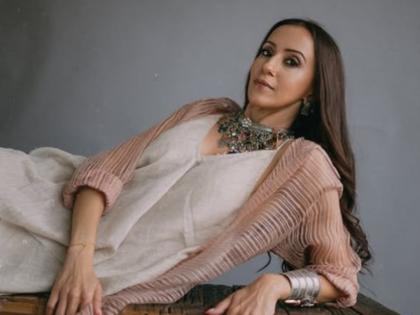
Ishitta Arun: “I Go After the Roles That Scare Me Most—The Messy, Wild, Unforgettable Ones”
Ishitta Arun is a versatile Indian artist—an actress, writer, VJ, producer, and lyricist—known for her standout roles in Scoop, Rana Naidu, and Good Bad Girl, as well as her work on projects like Dhaakad and Coke Studio. She’s also a fan favourite on Instagram for her sketch comedy, including the iconic “Dadarchi Aunty,” and her relatable Marathi content. In an exclusive interview with Lokmat Times, Ishitta opened up on her career, her creative journey, and the roles that inspire her most.
You’ve recently been featured in Single Papa on Netflix — what drew you to this role, and how was the experience different from your previous projects?
Thank you! Yes, you’ve recently seen me in Single Papa. And no, before you ask, this is not the usual North Indian aunty I’ve played all my life, either on screen or off. What excited me was that I’d never done this kind of role before. On paper, you’d imagine someone very different playing Meenu Aunty—someone older, louder, with stronger opinions about your life choices. But the show kindly decided to break stereotypes and cast… me. Meenu Aunty is called that by Gigi, who honestly isn’t that far from her in age, which I found both deeply personal and slightly offensive.
That gave me the freedom to build her my way. In my head, she’s a South Delhi woman who got married early, now has older friends, excellent judgment about people, and zero patience for nonsense. Basically, she’s an aunty by circumstance, not by spirit. And of course, I said yes because of the team: Shashank Khaitan, Juggernaut, Neeraj and Ishita writing it, and a stellar cast all around. At that point, the character could’ve been called Meenu Behen, Meenu Ma’am, or just Meenu shouting from the balcony—I was in.
You’ve worked across films, web series, and music projects — how do you approach such diverse creative mediums?
At the center of it all, I’m just an artist with a constant urge to express. The artist doesn’t change; only the playground does. Films, web series, theatre—they’re just different canvases where the same actor shows up, borrows a life, and feels things sincerely for the camera, the stage, or the audience. The roles change, the projects change, the medium changes, but the emotions don’t. Those come from the same place every single time. That’s the core of it for me: same heart, different costumes.
And then there’s writing. When I’m a lyricist, the canvas shifts again. The same artist, the same emotions, but now I’m not performing them outwardly. I’m quietly putting them into words. In films, web series, and theatre, you see me doing the feelings. In songs, you hear what I was feeling. So yes, I’m still the same artist—sometimes acting it out, sometimes confessing it in rhyme.
Your character ‘Dadarji Aunty’ has become iconic online. Did you expect it to resonate so widely with audiences?
Dadarji Aunty—no, I didn’t create her. She simply arrived, fully formed, like an opinion nobody asked for but everybody needed. She was born as a loving homage to my husband and his family, the Ghanekars, whose roots are firmly planted in Dadar Hindu Colony. That’s where it all began. Over twenty years of marriage, I’ve basically earned an honorary degree in Dadar and Shivaji Park Studies. I’ve heard stories, observations, and extremely detailed explanations of who stood where, who noticed what, and why it still matters.
My understanding of Maharashtrian nuances comes from years of close contact with an outrageously witty, sharply observant tribe. The Ghanekars are some of the funniest people I know. Their humour doesn’t shout; it watches quietly and then lands the punch. A big part of Dadarji Aunty is stitched together from their anecdotes and Dhruv’s running commentary on life.
What’s even funnier is that a lot of this happened while we were travelling. We’d be in Norway, surrounded by fjords and silence, and still end up discussing how Maharashtrians are everywhere—from foreign lands to food counters. Somewhere between Oslo and “arey, tu pan ikde?” Dadarji Aunty took birth. I had no idea people would connect with her the way they have. But I’m ridiculously proud because she represents my love for the Ghanekars, for Mumbai, and for Maharashtrians at large. She’s not a character I invented—she’s an observer who simply refused to stay quiet.
How important is language and cultural nuance, like in your Marathi sketches, to the humour you create?
Language and cultural nuance are the joke. Especially Marathi. Marathi isn’t just a language; it’s an emotion with timing, tone, and the rare ability to insult you so politely that you only realize it two hours later in the lift. You can translate the sentence, but you’ll never translate the pause, the look, or the judgment that arrives silently and sits with you. Marathi is love, memory, and cultural wealth. It’s made of habits, observations, and opinions generously shared. Cultural nuance is what makes humour sharp, specific, and unforgettable. And the funniest part? I’m not even Maharashtrian. Marathi was given to me like a gift—a very precious, slightly dangerous gift. One that I now use with full affection and absolutely no restraint.
With your background as a writer, lyricist, and producer, how do you balance social media content with long-form acting projects?
I think of social media as net practice. No pads, no protection—just reflexes. Long-form acting projects are like test matches. You have time, arcs, silences, budgets, and many people politely telling you to hold the emotion a little longer. Social media gives you ninety seconds. That’s it. If your idea hasn’t landed by then, the audience has already swiped to a dog, a recipe, or someone dancing.
That’s why short form is such great training. As a producer, you learn how to make something look good in ninety seconds. As a writer, you learn how to tell a full story in ninety seconds. And as a performer, you learn brutal honesty—because if it’s not engaging, it vanishes in ninety seconds. So I don’t see short form and long form as competing. One sharpens my instincts; the other lets me stretch. Social media keeps me going; long-form lets me go deep. Between the two, I’m basically in permanent creative cardio.
Which role or project so far has challenged you the most, and why?
Honestly, the roles that challenge me the most are always on stage. Theatre is the only place where you don’t get a retake, a cut, or a polite “let’s try that once more.” Once you’re out there, it’s live, it’s breathing, and if you mess up, the audience messes up with you. You have to be fully rehearsed, fully inside the character, and completely present. Theatre keeps you humble that way. On screen, thankfully, there are retakes, angles, and editing. But even then, Anna in Rana Naidu really stretched me. She was one of the few female characters who wasn’t operating at the mercy of a man. She was driving an extramarital affair, which already makes people uncomfortable, but she also had to be played with sensitivity. The challenge was to make sure you didn’t feel angry at her but empathetic. That you understood why she was there, and maybe even wanted her to end up with Tejas’ character because she was coming from an abusive marriage. It was messy, layered, uncomfortable, and very human—basically, the kind of role that makes you slightly nervous and then very grateful you said yes.
Looking ahead, what kinds of stories or characters are you excited to explore next?
I have so much more I want to express… like, so much. I’ve been pushing my limits as a creator, writer, actor… basically, as a human who refuses to stay in one box. Mostly because I’ve never figured out which box fits me anyway. I’m excited to get back into larger formats. I had paused them to focus on smaller formats—social media, short videos. Yes, ironic. But now I’m ready for everything again. And I want to do everything. Why can’t I? I’m here to prove that if I set my heart to it… I can. Or at least I’ll look convincing while panicking behind the scenes. Making fun content, producing my own movie, acting in it (and probably forgetting my lines spectacularly), writing an entire album… maybe even designing the costumes. Someone has to, right?
I want all sorts of roles—the messy, the wild, the beautifully complicated. The ones people think I cannot do… because, well, I can. And I will. Mostly because if I don’t, who will? I have one life. So why not spill it all out? Shake it up? Give everything I’ve got… and then some. Stories and characters that surprise me, challenge me, make me laugh, maybe even make the audience slightly uncomfortable. Because if you’re not pushing boundaries, you’re just rearranging furniture. And honestly… if a role looks impossible, confusing, or terrifying? That’s exactly the one I’m signing up for. Also, I’m here to continue my mother’s legacy—which is mostly excellence, occasionally chaos, and always a very loud opinion about everything. And if I fail spectacularly along the way… well, at least it’ll be hilarious. Either way, it’s going to be a show.
Through your work and social media, you’ve built a loyal audience — what’s your approach to staying authentic while engaging them?
I think staying authentic is everything. You can’t just post stuff to post stuff. You have to actually mean it—even if it’s small, messy, or makes zero sense. And honestly… every single person who shows up counts. Every like, comment, or awkwardly polite scroll-stopper—they matter. Because what am I without them? Just talking to my plants… and let me tell you, my plants are brutal. Zero engagement, zero laughs, zero validation. So I try to stay true to myself while remembering that these people are showing up, watching my nonsense, laughing, groaning, maybe judging me a little—and that’s sacred. I give back the same energy: fun, honesty, chaos, and occasionally a life lesson disguised as a joke. At the end of the day, authenticity isn’t a strategy. It’s realizing you’re only as real as the people who actually stick around to witness it. And if they laugh? That’s the jackpot. If they don’t… well, the plants are judging anyway.
Open in app