
After Maduro's arrest, US faces uncertainty over Venezuela transition
By IANS | Updated: January 5, 2026 06:20 IST2026-01-05T06:17:43+5:302026-01-05T06:20:18+5:30



Washington, Jan 5 The arrest of Nicolás Maduro has removed Venezuela’s most visible power figure, but US officials ...
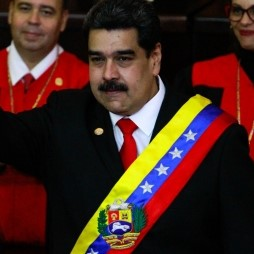
After Maduro's arrest, US faces uncertainty over Venezuela transition
Washington, Jan 5 The arrest of Nicolás Maduro has removed Venezuela’s most visible power figure, but US officials acknowledged deep uncertainty over who governs the country next and how a political transition might unfold.
Secretary of State Marco Rubio said the United States does not recognize Maduro or his successors as legitimate leaders but must deal with what he described as the immediate realities on the ground.
“We have to deal with the people who had the guns,” Rubio said in an interview on NBC’s Meet the Press, referring to Venezuelan security forces and institutions that remain intact.
Rubio confirmed in interviews with ABC News and CBS News that he had spoken with Vice President Delcy Rodríguez, who has assumed a leadership role following Maduro’s arrest. He declined to detail any commitments she may have made.
“What matters is what they do,” Rubio told CBS News’ Face the Nation. “We’re going to judge everything by what they do.”
Rubio stressed that engagement does not equal recognition. On ABC’s This Week, he said the United States has often had to deal with authorities it does not recognize in order to achieve limited objectives.
“That’s different from recognizing their legitimacy,” Rubio said on ABC News.
The question of legitimacy dominated Sunday discussions. Analysts appearing on CNN noted that Rodríguez has been sanctioned by both the United States and the European Union and was a central figure in Maduro’s government.
Journalist David Sanger of The New York Times said on CNN’s popular Sunday talk show GPS with Fareed Zakaria that the administration appears to be choosing pragmatism over democratic symbolism, dealing with whoever can deliver short-term compliance.
At the same time, some of the experts referred to opposition leaders María Corina Machado and Edmundo González, who claimed victory in the disputed 2024 election. She has remained outside the transition process so far.
Rubio acknowledged admiration for the opposition but said immediate elections were unrealistic after years of authoritarian rule. “Everyone wants an election tomorrow,” he told ABC News. “That’s absurd.”
“These things take time,” Rubio said on CBS News. “There’s a process.”
Military analysts warned that Venezuela’s armed forces remain powerful and cohesive. Former U.S. Southern Command chief Admiral James Stavridis said on CNN that Washington now faces difficult choices.
“You either work with existing structures, or you risk chaos,” Stavridis said, adding that a gradual transition may be the only viable option.
Rubio said the United States will continue to apply pressure through oil sanctions and maritime enforcement while watching how Venezuela’s interim leadership behaves.
“We retain multiple levers of leverage,” Rubio said on NBC News, pointing to the ongoing oil quarantine.
For now, Maduro is in US custody and facing prosecution. But as officials and analysts acknowledged on Sunday, removing one leader has not resolved the deeper question of governance.
“What comes next,” Stavridis said on CNN, “is the hardest part.”
Disclaimer: This post has been auto-published from an agency feed without any modifications to the text and has not been reviewed by an editor
Open in app