
Flour millers protest Sindh's wheat policy, allege subsidy favouring traders
By ANI | Updated: December 25, 2025 16:20 IST2025-12-25T16:19:04+5:302025-12-25T16:20:05+5:30


Karachi [Pakistan], December 25 : Flour mill operators have expressed their dissatisfaction with the Sindh government's inconsistent approach of ...
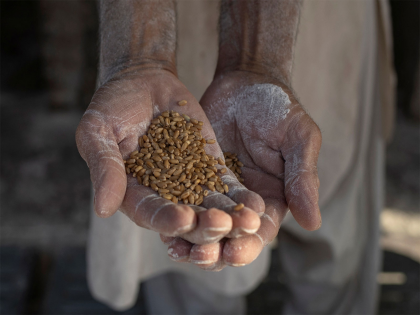
Flour millers protest Sindh's wheat policy, allege subsidy favouring traders
Karachi [Pakistan], December 25 : Flour mill operators have expressed their dissatisfaction with the Sindh government's inconsistent approach of providing a restricted wheat quota to millers under the Wheat Food Policy for FY25-26, while offering an unrestricted supply to traders, as reported by Dawn.
"It seems that the Sindh government's consumer subsidy will ultimately benefit traders, as the provincial administration sells wheat at Pakistani Rupees (PKR) 8,000 per 100kg bag, while traders then sell it to millers for PKR 9,500," stated Abdul Junaid Aziz, the Sindh zone chairman of the Pakistan Flour Mills Association (PFMA), during a press conference at the Karachi Press Club on Wednesday, accompanied by other association leaders.
He mentioned that it remains uncertain whether the PKR 1,500 per 100kg bag subsidy was intended for consumers, traders, or end users. He noted that the government had allocated PKR 85 billion for the subsidy fund. Over the last 10 days, traders have received wheat from the Pipri godown, while flour mills have been denied supplies, according to the Dawn report.
Aziz further pointed out that mills in Karachi and rural Sindh were assigned only 8,000 to 15,000 wheat bags per mill from Landhi godowns No. 1, 2, and 3, and nearly half of the available grain at these godowns is of inferior quality. He stated that the government had indicated that flour millers would receive wheat on a proportional basis, split evenly between Pipri and Landhi godowns.
"Millers have requested the government to conduct a joint inspection before the distribution of wheat from Landhi godowns to confirm that the grain is suitable for human consumption and not four years old, which could lead to severe health risks due to food poisoning. However, the Sindh Food Department is unwilling to perform any joint inspections. The association has sent multiple letters to the provincial government regarding this issue but has not received any replies," Aziz mentioned.
He remarked that traders were readily securing challans from the Sindh government for significant quantities of wheat, which, after collection from godowns in Karachi and rural Sindh, was being transported to Punjab and Khyber Pakhtunkhwa. "The subsidy intended for consumers of Sindh is being exploited by traders," he added, as reported by Dawn.
Aziz called on the Sindh government to revoke wheat allocations to traders and to supply grain to millers after implementing necessary changes to the policy. He asserted that while the Sindh government has claimed wheat stocks of 11.5 million tonnes, the actual inventory is between 7.5 million and 8.5 million tonnes, demanding a thorough investigation into the situation.
He indicated that the new Sindh wheat harvest would arrive in March. He stated that the government's wheat reserves would barely suffice for consumer needs for more than three months, advocating that the grain should not be allowed to leave Sindh at any price, as this could trigger an increase in flour prices, as highlighted by Dawn.
Disclaimer: This post has been auto-published from an agency feed without any modifications to the text and has not been reviewed by an editor
Open in app