
Pakistan’s trilateral plan an experiment in working around its paralysis: Report
By IANS | Updated: December 11, 2025 19:10 IST2025-12-11T19:06:49+5:302025-12-11T19:10:18+5:30


Jerusalem, Dec 11 Pakistan's proposal to expand its trilateral cooperation with Bangladesh and China into a South Asian ...
Pakistan’s trilateral plan an experiment in working around its paralysis: Report
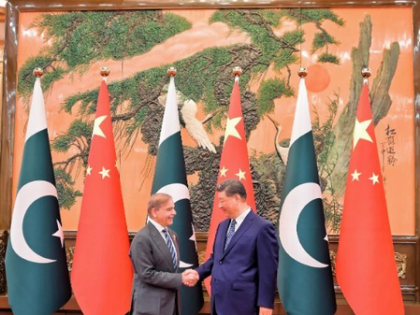
Jerusalem, Dec 11 Pakistan's proposal to expand its trilateral cooperation with Bangladesh and China into a South Asian bloc at its core demonstrates institutional failure. Framed as an alternative to the SAARC, the initiative showcases Islamabad's growing frustration with India-centric regional paralysis and wider reordering of power, partnerships and political concerns in South and West Asia, a report has stated.
Pakistan's trilateral pivot must be seen less as an act of diplomatic bravado and more as a response to strategic stagnation.
"Pakistan’s proposal to expand its emerging trilateral cooperation with Bangladesh and China into a broader South Asian bloc marks one of the most consequential diplomatic signals in the region in nearly a decade. Framed as an alternative to the moribund SAARC, the initiative reflects not only Islamabad’s growing frustration with India-centric regional paralysis but also a wider reordering of power, partnerships, and political anxieties across South and West Asia," wrote Restelli.
"At its core, the proposal is an admission of institutional failure. SAARC, conceived in 1985 as South Asia’s answer to ASEAN or the EU, now survives largely as a hollow shell. The last summit was held in 2014. Since India’s withdrawal from the planned 2016 Islamabad summit after the Kashmir attack, the organization has been effectively frozen by India–Pakistan hostility. What should have been the world’s most dynamic regional economic space instead remains one of its least integrated: intra-South Asian trade barely reaches 5 per cent of total commerce, compared to ASEAN’s 25 percent. Transport corridors remain blocked, energy cooperation is fragmented, and people-to-people movement is minimal," he added.
The expert reckoned that Bangladesh's participation is significant as Dhaka's ties with New Delhi have deteriorated since the ouster of former Bangladesh Prime Minister Sheikh Hasina. At the same time, economic realism is resulting in Bangladesh opting for diversified partnerships, particularly with China and now Pakistan, its historical rival turned partner. From India's perspective, this is not only about South Asian cooperation but also about encirclement, influence erosion and the rising sinicisation of its immediate neighbourhood, according to the report.
"For smaller South Asian states, the calculus is more nuanced. Nepal, Sri Lanka, Maldives, and even Bhutan face worsening debt, climate vulnerability, and fragile export economies. For them, rigid bloc politics offer little comfort. What they seek are financing, transport access, labour mobility, and climate adaptation mechanisms. If Pakistan’s proposal delivers tangible economic corridors, energy grids, and maritime connectivity rather than ideological alignment, these states may cautiously engage—quietly, incrementally, and without announcing strategic realignments," Restelli wrote.
"Yet the political costs remain high. Any formal structure perceived as excluding India risks backlash in trade, transport, tourism, and security cooperation. For most of South Asia, India is not merely a neighbour— it is the dominant transit market, energy hub, and financial partner. No alternative bloc can immediately replace that gravitational pull. What emerges instead is the rise of 'minilateralism': small, issue-focused groupings that function below the threshold of full alliance politics. This trend is already visible in BIMSTEC, BBIN, and various India-Japan-ASEAN and China-Pakistan-Central Asia frameworks. Pakistan’s trilateral plan fits squarely into this pattern. It is less a replacement for SAARC and more an experiment in working around its paralysis," he added.
Disclaimer: This post has been auto-published from an agency feed without any modifications to the text and has not been reviewed by an editor
Open in app