
We want to elevate bilateral ties to higher level: German Chancellor Merz calls India 'desired partner'
By IANS | Updated: January 12, 2026 14:05 IST2026-01-12T14:00:47+5:302026-01-12T14:05:21+5:30


Gandhinagar, Jan 12 German Chancellor Friedrich Merz on Monday expressed willingness to elevate bilateral ties with India to ...
We want to elevate bilateral ties to higher level: German Chancellor Merz calls India 'desired partner'
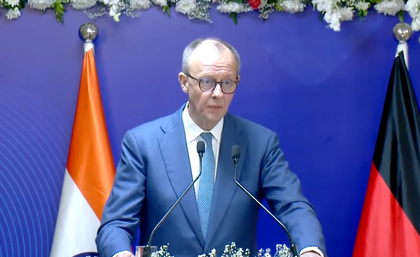
Gandhinagar, Jan 12 German Chancellor Friedrich Merz on Monday expressed willingness to elevate bilateral ties with India to a higher level. He stated that both nations share a fundamental interest in deepening the strategic partnership amid the geopolitical changes and upheavals in the world.
While addressing a joint press meet with Prime Minister Narendra Modi following their talks in Ahmedabad on Monday, Merz said, "Our two countries are seeking to intensify and deepen our cooperation. This morning, I had the opportunity to visit the birthplace of Mahatma Gandhi. Mahatma Gandhi has ascribed the following sentence: 'Be the change which you hope for the world.' We want to take heed of that together, dear Narendra Modi. We want to elevate the relations between India and Germany to an even higher and new level."
Merz expressed gratitude to PM Modi for inviting him to his home state, calling it a sign of the "very deep ties" between our two countries, and also a "testament to the friendship" towards him.
"This city, we're visiting today, Ahmedabad, in a certain way, is the cradle of modern India. This is where Gandhi started his non-violent struggle and fight for freedom, self-determination and democracy and the region, this part of India, Gujarat, represents an impressive economic dynamic, a dynamic of India ranging from the textile industry via highly modern smart industrial parks and to a very lively startup scene...Here in Gujarat, it becomes tangible what's important to both of us when it comes to this visit. The fundamental political values that we share, the tremendous economic potential that we see and our ever closer interconnections with a view to skilled labour and education and especially amid the profound geopolitical changes and upheavals in the world, we share a fundamental interest in deepening our strategic partnership," he said.
Merz mentioned that India and Germany are focusing on the principles of free trade and open markets as the world is witnessing a renaissance of protectionism. He expressed India and Germany's opposition to big powers using supply chains and raw materials as instruments of power.
"We're seeing a renaissance of protectionism. It's directed against the principles of free trade and open markets, and countries like India and Germany have been focusing on the principles of free trade and open markets, and we continue to focus on these principles in future. We are experiencing that great powers, big powers, use supply chains and raw materials increasingly as instruments of power. Together, we want to oppose this. We reduce unilateral dependencies of our supply chains, and that makes both of our economies more resilient. India, as the fastest-growing economy of the G20, is a pivotal partner in the Indo-Pacific," he said.
The German Chancellor called India a "desired partner" and "partner of choice" for Germany and stressed that the two nations share fundamental values and essential interests.
"Europe and transatlantic relations remain important to us today. We need to forge a broader network of partnerships, and we need to do so swiftly and with a long breath at the same time. India is a desired partner, a partner of choice for Germany and the preconditions for a renewed and deepened, and intensified partnership couldn't be more favourable. Germany is the most populous state and the state in the European Union which is the most economically strong state in the European Union, and India is the biggest democracy in the world. We share fundamental values, the highly dynamic India and the highly technological Germany. We share essential interests, and this is what we build upon."
Friedrich Merz stated that Germany advocates for an international order where people live freely and securely and pointed out the changing world order, terming Russia's military action in Ukraine as the "most drastic expression" of these changes.
"I want to focus on three priorities. First, we advocate for an international order in which we can live freely and securely because the world order is changing the moment we are meeting here; it is increasingly marked by great power politics and thinking on spheres of influence. Rough winds are blowing, and we have to brace ourselves against these rough winds. Russia's war of aggression against Ukraine is probably the most drastic expression of these changes and this upheaval. Together, we are going to assert these values and interests that we share in this new world together. No, we don't always agree on all matters, and that holds true for our European partners as well. But, the overlaps we're seeing are very big indeed, and this is why we want to cooperate more closely in the field of security policy," he said.
Expressing willingness to deepen cooperation with India in defence industries and in economic ties, Merz said, "We host joint exercises of our navy and our air force and we have joint port visits, military joint visits and we have forums of consultations and we want to deepen our defence industries and the cooperation of our defence industries and this has strategic significance that strengthens both and that leads to a fact that India is less dependent on Russia. You saw it. We signed a groundbreaking memorandum of declaration. One memorandum stipulates the closer cooperation of our defence industries in the field of development and production, and the promotion of innovation and strengthening global supply chains. But not only do we intensify our defence industrial cooperation, but we also intensify our economic relations."
Disclaimer: This post has been auto-published from an agency feed without any modifications to the text and has not been reviewed by an editor
Open in app