
When you look at foreign policy, you must have clarity, make choices, have a game plan: EAM Jaishankar
By ANI | Updated: December 20, 2025 18:40 IST2025-12-20T18:39:34+5:302025-12-20T18:40:05+5:30


Pune (Maharashtra) [India], December 20 : External Affairs Minister (EAM) S Jaishankar on Saturday emphasised the need for strategic ...
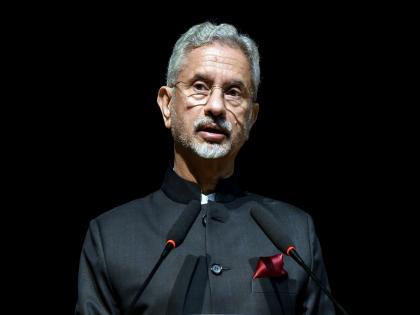
When you look at foreign policy, you must have clarity, make choices, have a game plan: EAM Jaishankar
Pune (Maharashtra) [India], December 20 : External Affairs Minister (EAM) S Jaishankar on Saturday emphasised the need for strategic clarity and a well-defined game plan for India's foreign policy, stating that the country must operate with a well-defined game plan to navigate an increasingly complex global environment.
Addressing an event at the Pune Book Festival, Jaishankar said that foreign policy cannot be driven by ambiguity or hesitation, underlining the importance of aligning India's interests with long-term strategic thinking.
"When you look at foreign policy, you must have clarity; you have to make the choices. As I said, you must have a game plan. You have to pick all the positive points that will work for you and make them work," he said.
Reflecting on intellectual influences, the EAM expressed frustration with Western-dominated textbook narratives, noting that India has never had a tradition of strategy and statecraft.
Jaishankar stressed that India has its own civilisational beliefs, culture and strategic traditions, which need to be articulated in India's own terms and communicated to the world.
"Most of the textbooks you get are written by Western people... I was tired of reading again and again that we are very strategic, but India has no tradition of strategy and statecraft... We have grown up with our beliefs, our culture... We don't use our own terms, and the world doesn't know our own terms either... It was this feeling that was growing in me... I want to explain to the world what I have felt for a long time," he stated.
Highlighting current geopolitical challenges, Jaishankar said that India's engagement with major global powers has become more complex, adding that Europe remains an important partner which requires greater effort and attention from New Delhi.
The EAM acknowledged the political sensitivities involved in India's neighbourhood policy, stressing the need to maintain stability in relations despite fluctuations.
"Engaging America has become more complicated. You all know why. Managing China has become complicated. Reassuring Russia became complicated because of the Ukraine war and the pressure on us to move away from Russia... Europe is one very important partner with whom we need to make more effort," he said.
"And then when you come to the neighbourhood, the neighbours we have are smaller than us and every one of them is linked to us. Politics happens there too. Things go up and down. Sometimes they praise us, sometimes they criticise us. Because we are actually an issue in their politics as well. Knowing it will go up and down, how do you make sure the relationship is as steady as possible?" the EAM added.
Jaishankar cited India's role during regional and global crises as an example of its responsible foreign policy.
Referring to recent assistance to Sri Lanka during and following Cyclone Ditwah, he said India responded within the same day.
He also highlighted India's role during the COVID-19 pandemic and the Ukraine conflict, noting that vaccines, fuel, wheat and fertilisers were supplied to neighbouring countries when global supply chains were disrupted.
"We have to find a way," the EAM emphasised.
Discussing India's historical and cultural ties, Jaishankar spoke about the Gulf region, Southeast Asia and Central Asia.
He referred to Oman's long-standing maritime links with India's western coast and said that historical disruptions had distanced regions that were once closely connected.
"This week, I was in the Gulf. The history of the Gulf is very, very close to the history of India. When the Prime Minister went there, I'm talking about Oman. Oman used to be a big trading kingdom. From there, people used to travel along the coastline to the coastlines of Maharashtra and Gujarat. They used to come and go by boat every day. Because of the partition, somehow someone came in between. You know who came in between. Then they became distant from us. They moved a couple of regions further away. So, how to rebuild that feeling? Rebuild it in the Gulf, rebuild it in Southeast Asia, rebuild it in Central Asia," he said.
Urging the citizens to recognise India's civilisational footprint abroad, Jaishankar said, "Wherever you go, in the Gulf, in Southeast Asia, in the Indian Ocean or in Central Asia, look for the impact, the imprint of India. You will be surprised how much the imprint of India is there," pointing out that the largest Hindu temple is located in Cambodia, underscoring India's deep cultural influence beyond its borders.
Concluding his remarks, the External Affairs Minister reiterated that India's foreign policy must leverage all its strengths.
Disclaimer: This post has been auto-published from an agency feed without any modifications to the text and has not been reviewed by an editor
Open in app