
Why Is It Still Called Mumbai-Pune Expressway ‘Missing Link’? It’s Not Missing, It’s Connecting, Says CM Devendra Fadnavis
By Lokmat Times Desk | Updated: May 2, 2026 09:07 IST2026-05-02T09:01:35+5:302026-05-02T09:07:32+5:30



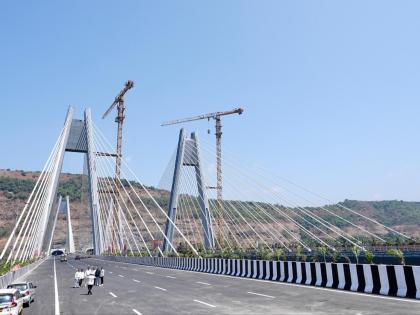
The name Mumbai-Pune Expressway 'Missing Link' sounds like some part of the cable wire bridge is missing from the ...
Why Is It Still Called Mumbai-Pune Expressway ‘Missing Link’? It’s Not Missing, It’s Connecting, Says CM Devendra Fadnavis
The name Mumbai-Pune Expressway 'Missing Link' sounds like some part of the cable wire bridge is missing from the middle or at the starting point or ending side, but this is not the case in the name of a newly constructed cable bridge that set a Guinness World Record as connecting the world’s widest tunnel.
While the expressway, which is also known as the Yashwantrao Chavan Expressway, connects two major cities in Maharashtra, the Lonavala-Khandala created a bottleneck that led to massive traffic jams. This newly inaugurated bridge will fill this gap and cut the travel time by nearly 30 minutes.
What Exactly Is The ‘Missing Link’?
The 13 km stretched connected via cabled wire bridge called 'Missing Link' emerged as it project target to fill the missing gap between Mumbai-Pune Expressway and the newly inaugurated tunnel, which has widen the ghat section also bypasses the older way.
Also Read | Mumbai-Pune Missing Link Opens Today; Here's How Much Travel Time Will Be Reduced Between Two Cities.
It connects Khopoli to Kusgaon through a straighter, more direct route carved into the hills. The Missing Link helps commuters to avoid steep climbs and sharp turns. In simple terms, it replaces a slow, difficult drive with a shorter, smoother one, bringing the expressway closer to its original promise of fast, seamless travel.
When the Mumbai-Pune Expressway was first built, the steep terrain of the Sahyadri mountains made it technically difficult to maintain a consistent 6-lane high-speed corridor through the Khandala and Lonavala ghats. For years, traffic was forced into a bottleneck where the Expressway and the old NH-4 merged, causing massive congestion and frequent accidents. This project was conceptualised to create a dedicated, separate bypass that remained part of the Expressway's high-speed standard.
Not Missing, It’s Connecting: CM Devendra Fadnavis
“The ‘Missing Link’ on the Mumbai-Pune Expressway is not just a road but a world-class example of Indian engineering prowess. This project will not only save travel time, but will also act as an ‘economic multiplier’ that will give a boost of Rs 70,000 crore to the state’s economy,” said CMDevendra Fadnavis on Friday.
आजच्या दिवसाचा सारांश | शुक्रवार, 01 मे 2026
— CMO Maharashtra (@CMOMaharashtra) May 1, 2026
प्रधानमंत्री नरेंद्र मोदी यांच्याकडून मुख्यमंत्री देवेंद्र फडणवीस यांचे कौतुकhttps://t.co/QekEZV9BQs
मिसिंग लिंक नव्हे तर कनेक्टिंग लिंक..! - मुख्यमंत्री देवेंद्र फडणवीसhttps://t.co/j90PH3v33A
मिसिंग लिंक प्रकल्पातील बोगद्याचा…
Speaking at a press conference organised after the inauguration of the project, the Chief Minister highlighted the technical and safety aspects of the project, saying that it is more appropriate to call it a ‘Connecting Link’ rather than a ‘Missing Link’.
Fadnavis stated, “Earlier, we used to call it a ‘Missing Link’, but now it would be more appropriate to call it a ‘Connecting Link’… nothing is missing now… everything is in place.”
While giving information about the project, Fadnavis said that passenger safety has been given top priority and that the route is technically very advanced. It features a state-of-the-art firefighting system, water mist system, and emergency telephone facilities every 50 metres. As a special safety measure, ‘connectors’ linking both tunnels have been constructed every 300 metres so that, in case of an accident in one tunnel, passengers can be safely evacuated through the other.
There is 24-hour CCTV surveillance across the entire route, and an Intelligent Traffic Management System has been implemented to ensure lane discipline is followed. The Chief Minister also warned that e-challans will now be sent directly to vehicle owners who violate traffic rules.
Stating that completing the project in difficult geographical conditions, including valleys and forests, while transporting heavy machinery was a major challenge, the Chief Minister thanked the expert organisations and companies from seven countries that contributed to the work.
Open in app