
Anyone involved in terrorism is threat to country and should be hanged: Ajit Pawar (IANS interview)
By IANS | Updated: January 12, 2026 13:25 IST2026-01-12T13:23:45+5:302026-01-12T13:25:08+5:30


Mumbai, Jan 12 Ahead of the forthcoming Brihanmumbai Municipal Corporation (BMC) elections scheduled for January 15, 2026, Nationalist ...
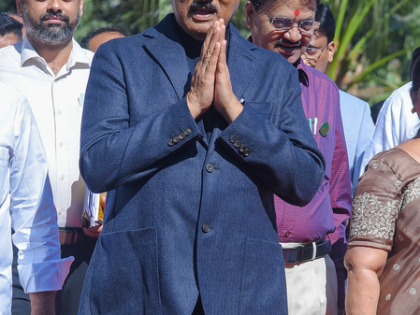
Anyone involved in terrorism is threat to country and should be hanged: Ajit Pawar (IANS interview)
Mumbai, Jan 12 Ahead of the forthcoming Brihanmumbai Municipal Corporation (BMC) elections scheduled for January 15, 2026, Nationalist Congress Party (NCP) leader and Maharashtra Deputy Chief Minister Ajit Pawar on Monday said that his party’s sole focus is development. Pawar outlined the priorities mentioned in the party’s manifesto, addressed questions about alliances, political realignments, governance, and national issues, and reiterated that voters ultimately judge leaders on their work. He also said that anyone involved in terrorism should face the strictest punishment and be hanged
A total of nearly 1,700 candidates are contesting the 227-ward BMC elections, which are being closely watched as they are considered a crucial political barometer ahead of future Assembly and Lok Sabha contests in Maharashtra.
The NCP on Wednesday released its manifesto for the BMC elections. The party has promised inclusive development, transparent governance and major infrastructure improvements to make Mumbai a global city. Their key plans include building 500 kms of new roads in the next five years, improving bridges and flyovers, using AI-based traffic management systems, and creating new economic hubs in places like BKC, Worli and the eastern suburbs to increase job opportunities.
NCP and Sharad Pawar's NCP (SP) formed an alliance for the Pune and Pimpri-Chinchwad municipal corporation elections despite being on opposite sides in the state and at the Centre. The NCP is with the governing alliance in both governments, while the NCP (SP) is in the Opposition.
In an exclusive interview with IANS, Ajit Pawar spoke on a wide range of issues, including civic governance, infrastructure development, pollution, political alliances, the possibility of reunification within the NCP, statements by Opposition leaders, and concerns related to national security and economic challenges.
Here is the full interview:
IANS: You have been in power for many years. What is new in this year’s manifesto?
Ajit Pawar: The most important new aspect of this year’s manifesto is our clear and focussed commitment to improving the quality of life in cities. People should get clean and sufficient drinking water, cleanliness should be maintained on a daily basis, roads should be in good condition, and traffic should be managed efficiently. Medical facilities must be accessible and of good quality for all citizens.
We are also paying special attention to pollution, which has become a serious issue in metropolitan areas like Mumbai. Due to rising pollution levels, people are falling ill and facing several health problems. These concerns have been reflected clearly in our manifesto. Our aim is not just to make promises, but to ensure effective implementation on the ground.
IANS: Since you have served as a minister for several years, people are saying that these facilities could have been provided earlier. What would you like to say about this criticism?
Ajit Pawar: I have served in the Pimpri-Chinchwad Municipal Corporation for nearly 25 years. Anyone can go and verify my work during that period. One should ask about the development work carried out there and how Pimpri-Chinchwad received recognition as one of the best-managed cities. At one point, Pimpri was known as the richest municipal corporation in Asia.
However, today the situation is different. Bills worth nearly Rs 4,000 crore are pending, and municipal bonds have been issued, which usually happens when there is a shortage of funds. In such circumstances, it becomes difficult to manage civic services efficiently. People are not getting adequate water supply, roads are in poor condition, and there are gaps in service delivery.
At the same time, employment opportunities must be provided fairly, based on merit and qualifications. Development cannot be selective; it has to be inclusive and sustainable.
IANS: You did not form alliances with the BJP or Shiv Sena in Pune and Pimpri-Chinchwad, even though you are together at the state level. What is the main reason for not having an alliance at the local level?
Ajit Pawar: Perhaps many people are not aware, but local body elections are different from Assembly or Lok Sabha elections. From 1999 to 2014, we fought local body elections separately. This is not something new. Every party has its own cadre and workers at the grassroots level, and everyone wants opportunities for their workers. That is why, in municipal elections, parties often contest independently.
IANS: What about the workers of the NCP-SP? Don’t you think they should also get opportunities?
Ajit Pawar: There is nothing wrong in that. We formed alliances to ensure that votes are not divided unnecessarily. Our aim is to secure a good result in the elections, and we are confident that our strategy will help us achieve that.
IANS: Are there any chances that the two factions of the NCP will come together?
Ajit Pawar: Right now, our top priority is to win the elections. We are doing everything possible to achieve a positive result, and that is where our focus lies at the moment.
IANS: What would you like to say about the possibility of the NCP and NCP-SP coming together?
Ajit Pawar: We are one family. In any family, people come together during times of happiness and sorrow. If family members choose to stand together, there is nothing wrong in that.
IANS: In Ambernath, you are aligned with the Shiv Sena faction led by Eknath Shinde. How do you explain this?
Ajit Pawar: If you look across Maharashtra, you will find many such examples. In 29 municipal corporations, alliances differ from place to place. In some areas, Shiv Sena and BJP are together; in others, the two NCP factions are together. This is common in local body elections. With only a few days left for polling, I want people to focus on real issues like water supply, cleanliness, quality of work, and overall development.
IANS: Don’t such varying alliances create confusion among voters?
Ajit Pawar: No, this is quite normal in local body elections. Parliamentary and Assembly elections are different. People are mature enough to understand these differences. Ultimately, voters decide based on who can deliver development and serve their area better.
IANS: NCP is often considered strong in Pimpri-Chinchwad and Pune. Is the alliance with NCP-SP aimed at protecting that stronghold?
Ajit Pawar: There is no truth in that assumption.
IANS: You once said that leaders are lured or pressurised into changing parties. Whom were you referring to?
Ajit Pawar: Before every election, such things happen across parties. The media may interpret statements in different ways, but people across Maharashtra know that I speak what I see and what I believe to be true.
IANS: The Thackeray brothers have come together. Do you think this will revive their political strength and help polarise voters?
Ajit Pawar: They are certainly trying hard. Shiv Sena (UBT) and MNS traditionally had different voter bases. Now that they have come together, vote division between them may reduce, which could benefit them. That is the reality.
IANS: Do you see yourself playing any role in bringing them together?
Ajit Pawar: I would like to congratulate them. It is always good when relationships improve within a family.
IANS: Do you think Marathi voters will support only the Thackerays?
Ajit Pawar: It doesn’t work that way. Voters think differently in different elections. During the Lok Sabha elections, the Opposition won 31 out of 48 seats in Maharashtra. But just five months later, the situation changed in the Assembly elections, where we won 238 seats and the Opposition was reduced to 85. This clearly shows that voters have different perspectives for national, state, and local elections.
IANS: You once remarked that a party which accused you of a Rs 70,000 crore scam is now sharing power with you. What do you want to say about that?
Ajit Pawar: At that time, I was asked a question and I responded accordingly. Even now, I am answering your questions honestly.
IANS: Who finalises the policies of the current Maharashtra government?
Ajit Pawar: Policy decisions are finalised collectively. Chief Minister Devendra Fadnavis finalises policies for the government, Eknath Shinde takes decisions for Shiv Sena, and I am responsible for the NCP. Each party may make its own statements, and that is their prerogative.
IANS: There were reports about plans to set up detention centres. What is your response?
Ajit Pawar: There were no such discussions. If anything of that sort had happened, I would have been aware of it. Since there was no such proposal, there is nothing to comment on.
IANS: There are reports of increasing terrorist activities in Maharashtra.
Ajit Pawar: Anyone involved in terrorism is a threat to the country and should face the strictest punishment and should be hanged. Terrorism cannot be tolerated under any circumstances.
IANS: Waris Pathan said that a ‘Khan-Pathan’ will become mayor of Mumbai. Do you see any issue with that?
Ajit Pawar: Anyone can become mayor. All Maharashtrians are equal, and anyone from among them can hold such a position.
IANS: Owaisi said that a hijab-clad woman will become Prime Minister. Your response?
Ajit Pawar: Such statements are often made to remain in the news. We should focus on serious issues like development. The younger generation wants progress, jobs, and infrastructure. Statements that harm social harmony or distract from development should not be promoted.
IANS: You promised free facilities, but leaders like Chandrakant Patil are opposing such ideas.
Ajit Pawar: Only the Chief Minister can make commitments for the entire state, and the Prime Minister for the country. I am speaking about local bodies, where I have worked for 25 years. If we win, we will try our best to deliver on our promises.
IANS: NCP, Shiv Sena, and AIMIM joined hands in Parli Municipal Corporation. Your view?
Ajit Pawar: As I said earlier, such alliances are common in local body elections across Maharashtra. Not every leader is informed about every decision, especially when things are finalised at the local level.
IANS: There are speculations that Supriya Sule may join the BJP.
Ajit Pawar: I am not an astrologer. Such speculative questions often become breaking news unnecessarily. I prefer to focus on development until January 15.
IANS: BJP leader K. Annamalai said that Mumbai is not a Maharashtra city.
Ajit Pawar: Mumbai is in India, and within India, it is in Maharashtra. Mumbai will always remain a part of Maharashtra. Such statements are made close to elections to attract attention, not to promote development.
IANS: Should Sharad Pawar be awarded the Bharat Ratna?
Ajit Pawar: That decision rests with the Central government. Sharad Pawar has served public life for over 60 years and taken many important decisions. Anyone can express an opinion on that.
IANS: Do you always aim to finish at the top in elections?
Ajit Pawar: Every party wants to perform well and secure the top position. There is nothing wrong in that.
IANS: Who do you think people will choose in the January 15 elections?
Ajit Pawar: People observe everything and vote for those who work for them.
IANS: You mentioned ‘Trimurti’ as an obstacle to development in Pune. Who are they?
Ajit Pawar: The people of Pune know that very well.
IANS: How do you view Prime Minister Narendra Modi as a leader?
Ajit Pawar: Prime Minister Modi is doing very well as a leader. He is taking the country to new heights and working towards making India the third-largest economy in the world. So, everything is going good.
IANS: How are US-imposed tariffs impacting Maharashtra?
Ajit Pawar: Tariffs affect everyone. If Indians promote ‘Made in India’ products, many of these challenges can be addressed.
IANS: Where do you see the Congress in this election?
Ajit Pawar: The results will show where the Congress stands when they come out.
IANS: How do you see Rahul Gandhi as a leader?
Ajit Pawar: He is trying hard, but success has eluded him so far. Everything is on the people and in democracy, people decide.
IANS: Hindus are facing atrocities in Bangladesh. How do you view this?
Ajit Pawar: Any atrocity against anyone is wrong. Such actions must stop, and both countries’ leadership should address the issue.
Disclaimer: This post has been auto-published from an agency feed without any modifications to the text and has not been reviewed by an editor
Open in app