
Bangladesh: Jamaat-e-Islami's attempts to rebrand itself an eyewash
By IANS | Updated: December 28, 2025 18:40 IST2025-12-28T18:35:10+5:302025-12-28T18:40:07+5:30


New Delhi, Dec 28 The forced ouster of the Sheikh Hasina-led Bangladesh government last year created conditions that ...
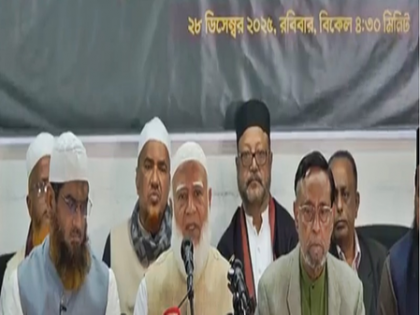
Bangladesh: Jamaat-e-Islami's attempts to rebrand itself an eyewash
New Delhi, Dec 28 The forced ouster of the Sheikh Hasina-led Bangladesh government last year created conditions that allowed radical, fundamentalist and Islamist forces to rear their heads, pushing the nation towards instability and chaos.
Bangladesh Jamaat-e-Islami (BJI), a radical outfit, has since worked aggressively towards its political resurgence, attempting to project itself as a moderate and inclusive party while rebranding its image through "anti-fascist" rhetoric. However, Jamaat’s claims and proposals have only exposed its dark underbelly, bringing to light its open support for radical elements and criminal groups, alongside deep-seated hostility towards minorities.
Today, Bangladesh under the interim regime of Muhammad Yunus stands at a crossroads, with citizens confronted by a stark choice between moderate voices and radical forces. Despite Yunus’ repeated advocacy of peace and harmony, the country’s political trajectory continues to tilt towards Islamic radicalism, with mainstream discourse increasingly marred by bigotry and vitriol -- elements that form the ideological core of Bangladesh Jamaat-e-Islami.
While Jamaat has sought to shed its hardline image and present itself as a “pro-uprising” force, such efforts remain an eyewash. The radical outfit has been unable to abandon its violent legacy and continues to foster what observers describe as an “environment of hatred” against the country’s minorities.
The party has also attempted to position itself as an “anti-fascist” and “pro-uprising” force by equating the sacrifices of 1971 with those of 2024, while projecting the latter as Bangladesh’s “second and true independence”.
However, Jamaat-e-Islami’s commitment to Sharia-based governance and its disregard for constitutional or man-made laws remain well documented.
“Jamaat has been a strong proponent of Islamic governance over electoral outcomes and has repeatedly stated that the state would be run on the basis of Islam if Jamaat secures an electoral majority, as the current constitution and laws are man-made,” said a report by International Science for Peace Studies, a research centre focused on South and West Asia.
Over the past year, Bangladesh’s political upheaval has coincided with a resurgence of Jamaat and a pronounced shift towards Islamic rhetoric in mainstream politics.
“The country has been witnessing increasing mob violence driven by the rise of Islamist radicalism. If Jamaat gains political strength, it is likely to further Islamicise Bangladesh’s political landscape and legitimise such violence,” the report said.
Notably, Bangladesh’s national elections have been announced for February 12 next year -- the first since the fall of the Sheikh Hasina-led government. With the Awami League barred from electoral participation, the Bangladesh Nationalist Party (BNP), Bangladesh Jamaat-e-Islami (BJI) and the National Citizen’s Party (NCP) remain the principal contenders.
While the BNP is expected to contest the elections on its own, Jamaat-e-Islami has entered into an electoral arrangement with seven “like-minded” parties for the polls.
Disclaimer: This post has been auto-published from an agency feed without any modifications to the text and has not been reviewed by an editor
Open in app