
Criticism based on facts helps our democracy, motivated fatalism doesn’t: Hardeep Puri
By IANS | Updated: January 8, 2026 16:35 IST2026-01-08T16:30:51+5:302026-01-08T16:35:10+5:30



New Delhi, Jan 8 Union Minister Hardeep Singh Puri said on Thursday that India’s democracy benefits by criticism, ...
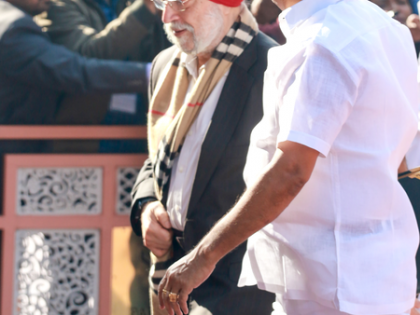
Criticism based on facts helps our democracy, motivated fatalism doesn’t: Hardeep Puri
New Delhi, Jan 8 Union Minister Hardeep Singh Puri said on Thursday that India’s democracy benefits by criticism, but not by motivated fatalism by some “experts,” who seem more guided by their politics rather than academic rigour.
“As we step into 2026, public debate in India should begin with a little New Year discipline, not by packaging insinuations, assumptions and shoot and scoot assertions as economic analysis,” the minister observed in a post on X.
He further stated that in recent years, a genre of commentary has emerged that reduces the work of reform to caricature, treats every imperfect transition as proof of permanent failure.
“The refrain is familiar and sweeping: India’s data sets are unreliable, economic growth is not benefitting the poor, there is crony capitalism, India cannot manufacture at scale etc. etc,” the minister remarked.
He further stated that each of the above assertions do not stand the scrutiny of facts. “Under the leadership of Prime Minister Narendra Modi, India has chosen the harder path of execution, and it is the results, audited in numbers and felt in households, that will outlast any brief for despair,” Puri added.
The minister wrote that "as we step into 2026, public debate in India should begin with a little New Year discipline."
“We should welcome scrutiny, even sharp criticism, but we should also insist that the argument carries responsibility. A republic of over 1.4 billion people cannot be reformed by cynicism. Jobs, productivity, exports, and inclusion are not easy at the best of times, and progress comes through the unglamorous grind of design, implementation, correction, and scale. A New Year is also a moment to separate scepticism from pessimism,” he observed.
"In recent years, a genre of commentary has emerged that reduces the work of reform to caricature, treats every imperfect transition as proof of permanent failure, and offers a familiar consolation: India is supposedly doomed by its own policymakers. That posture weakens trust in statistics and markets, encourages fatalism among entrepreneurs and investors, and hands outside actors a ready-made script for pressuring India in negotiations. Expertise must remain answerable to facts," Puri further stated.
“It is worrying to note that a few commentators, who boast of a strong professional and academic background, have resorted to such posturing. Some, whom I have known personally and who have anchored their identity and credibility in India, are now trying to make a career out of badmouthing the country,” he added.
The minister further highlighted that the charge that India’s datasets are uniquely unreliable sits uneasily with the direction of travel. The GST created a national invoice trail and a compliance culture that simply did not exist a decade ago. Digital payments created another audit footprint. In November 2025, UPI recorded 20 billion transactions worth over Rs 26 lakh crore. These are large, verifiable systems, and they expand the space for measurement, cross-checks, and course correction.
"Measured outcomes in welfare and inclusion further puncture this fatalism. NITI Aayog’s National Multidimensional Poverty Index shows almost 24 crore Indians moved out of multidimensional poverty between 2013-14 and 2022-23, with the incidence falling from nearly 30 per cent to about 11 per cent.
"Direct Benefit Transfer tightened delivery, with cumulative transfers crossing Rs 45 lakh crore in 2025 and savings of more than Rs 3.5 lakh crore through leakage reduction over the DBT period. Financial inclusion is now a mass infrastructure, with over 56 crore Jan Dhan accounts," he added.
Disclaimer: This post has been auto-published from an agency feed without any modifications to the text and has not been reviewed by an editor
Open in app