
Did Lord Ayyappa’s shadow fall on Devasom Ministers' poll defeat?
By IANS | Updated: May 6, 2026 11:05 IST2026-05-06T11:04:05+5:302026-05-06T11:05:05+5:30



Thiruvananthapuram, May 6 After the Left Front's loss in the recently concluded Assembly elections, questions are being asked ...
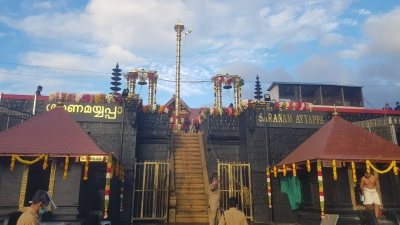
Did Lord Ayyappa’s shadow fall on Devasom Ministers' poll defeat?
Thiruvananthapuram, May 6 After the Left Front's loss in the recently concluded Assembly elections, questions are being asked whether the loss has any links with the Sabarimala case.
Did the aura of Lord Ayyappa and the scam surrounding Sabarimala Temple play a decisive role in the defeat of two key Devasom Ministers in Kerala’s 2026 Assembly elections? The losses of senior CPI(M) leaders have triggered precisely that question in political circles.
The elections saw the unexpected downfall of Kadakampally Surendran and V.N. Vasavan, both of whom had handled the sensitive Devasom portfolio, overseeing temple administration, including Sabarimala, across the two terms of the Pinarayi Vijayan government.
Surendran, who was seeking a hat-trick of victories from Kazhakootam, had served as Devasom Minister during the Left’s first term (2016-21). He was defeated by senior BJP leader V. Muraleedharan. In a parallel upset, Vasavan, who held the portfolio in the second term (2021-26), lost in his home turf to debutant Congress leader Natakam Suresh.
While anti-incumbency and local factors certainly played a part, the shadow of Sabarimala loomed large over the campaign narrative.
Both the Congress and the BJP aggressively raised the alleged ‘Sabarimala gold scam’ as a key poll plank, targeting not just the two ministers but the Left government as a whole.
The issue resonated beyond constituency boundaries, feeding into a broader perception battle over the government’s handling of temple affairs.
Sabarimala has long been more than a religious centre; it is an emotional and political touchstone in Kerala.
Any controversy linked to it tends to ripple across the state’s electorate.
In this election, opposition parties appeared to have successfully tapped into that sentiment, turning administrative questions into political liabilities for those directly associated with the Devasom portfolio.
For the CPI(M), the defeats of two leaders closely tied to temple administration raise uncomfortable questions.
Was this merely a coincidence shaped by local dynamics, or did the cumulative weight of Sabarimala-related controversies influence voter behaviour in a more decisive way?
There may be no straightforward answer. Yet, the symbolism is hard to ignore: two ministers linked to the stewardship of one of India’s most revered temples lost their electoral battles in the same election cycle.
In Kerala’s deeply layered political landscape, where faith and governance often intersect, the verdict suggests that narratives built around belief and trust can carry significant electoral consequences.
Disclaimer: This post has been auto-published from an agency feed without any modifications to the text and has not been reviewed by an editor
Open in app