
Gujarat to begin Census 2027 self-enumeration from May 17, door-to-door house-listing in June
By IANS | Updated: May 12, 2026 19:55 IST2026-05-12T19:54:20+5:302026-05-12T19:55:05+5:30



Gandhinagar, May 12 Gujarat will deploy more than 1.09 lakh enumerators and launch a two-week self-enumeration drive later ...
Gujarat to begin Census 2027 self-enumeration from May 17, door-to-door house-listing in June
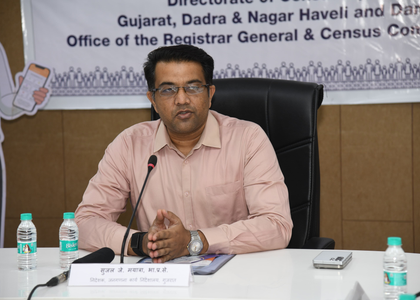
Gandhinagar, May 12 Gujarat will deploy more than 1.09 lakh enumerators and launch a two-week self-enumeration drive later this month as preparations intensify for Census 2027, officials said at a press conference in Gandhinagar on Tuesday.
The Directorate of Census Operations, Gujarat, said citizens across the state will be able to voluntarily submit details relating to their houses, household facilities and assets through the self-enumeration portal from May 17 to May 31, marking the first time such a digital participation system has been introduced in the national census exercise.
Briefing on the process, Census Operations Director Sujal Mayatra said the initiative was aimed at increasing public participation and improving the speed and accuracy of data collection through digital governance measures.
“The self-enumeration portal has also been launched, in which every citizen can proactively participate and provide their own information,” Mayatra said.
He further added, “My request to all citizens is to make maximum use of this, due to which better and faster data can be obtained.”
The state-wide House-listing Operations (HLO), involving door-to-door visits by census officials, will be carried out from June 1 to June 30 through a dedicated mobile application developed for census field work.
Officials said the first phase would focus on counting houses and collecting housing-related data, while population enumeration would be conducted separately in February 2027.
According to figures shared during the briefing, Gujarat has 34 districts, 268 talukas, 18,117 villages, 197 towns and 17 municipal corporations.
For the census exercise, the state has prepared 51 Principal Census Offices (PCOs), 624 charges and 1,10,598 House-listing Blocks (HLBs).
The state will deploy 1,09,038 enumerators, along with a reserve pool of 11,169 staff, while 18,254 supervisors and an additional reserve of 2,187 supervisors have also been assigned for the exercise.
Mayatra said each enumerator would be expected to cover data relating to approximately 700 to 800 persons during the 30-day field operation period.
“The 30-day data period is sufficient for them,” he said, adding that the involvement of Booth Level Officers (BLOs) and other personnel could further accelerate the process.
Officials said intensive training sessions for census staff were underway and would continue for two weeks to familiarise personnel with procedures and digital systems.
Responding to concerns regarding workload on government employees, particularly teachers, Mayatra said: "The matter was being coordinated with the state government and it is a policy decision to be taken by the state authorities."
During the briefing, officials said the house-listing exercise would involve 33 questions covering the condition and use of houses, ownership status, number of rooms, drinking water sources, electricity access, toilet facilities, drainage systems, bathing facilities, cooking arrangements and fuel used for cooking.
Information will also be collected on household assets and digital connectivity, including access to internet services, smartphones, televisions, radios, computers, vehicles and mobile phones.
Enumerators will also record details relating to the main cereal consumed by households, including rice, wheat, juwar, bajra and maize.
Officials said respondents would additionally be asked about the materials used in the floor, walls and roof of houses, whether the structure was residential or commercial, the condition of the house, and details of household members, including gender and social category.
Compared with the 2011 census, new questions have been added relating to internet access, smartphone usage, bottled water consumption and the main grain consumed in households.
"The department would not seek proof documents from residents, and that information related to building use would not involve verification of Building Use (BU) permissions or similar approvals," he noted.
Officials also stressed that information collected during census operations would remain confidential under the provisions of the Census Act, 1948.
Citizens were urged to cooperate with enumerators and provide accurate information during both self-enumeration and field verification visits.
Explaining the verification process, Mayatra said data entered through self-enumeration would remain in draft form until confirmed by an enumerator during the physical visit. “Unless the enumerator himself submits the data, the data is not saved,” he said.
Disclaimer: This post has been auto-published from an agency feed without any modifications to the text and has not been reviewed by an editor
Open in app