
IAF veteran recalls 1971 surrender moment captured in iconic painting
By IANS | Updated: December 16, 2025 16:40 IST2025-12-16T16:37:24+5:302025-12-16T16:40:14+5:30


New Delhi, Dec 16 The moment of Pakistan Army’s Lieutenant General Amir Abdullah Khan Niazi signing the Instrument ...
IAF veteran recalls 1971 surrender moment captured in iconic painting
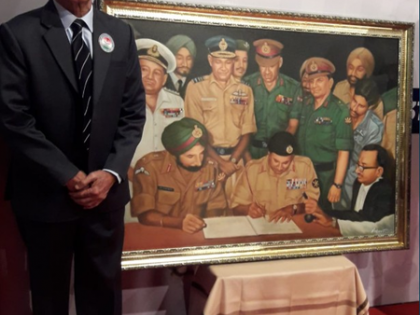
New Delhi, Dec 16 The moment of Pakistan Army’s Lieutenant General Amir Abdullah Khan Niazi signing the Instrument of Surrender under the supervision of India’s Lieutenant General Jagjit Singh Aurora is caught in an iconic painting which is now housed at the Manekshaw Centre, named after the Field Marshal who famously led the 1971 war.
Among the officers present on that historic occasion on December 16, 1971, is a young pilot who is also in the frame, trying to take a closer look at the Instrument, peeping over the then Major General Jack Farj Rafael Jacob’s shoulder.
It was Wing Commander Sundaram Krishnamurthy, now retired, then a Pilot Officer with the Indian Air Force helicopter unit, which took part in the 1971 war. Apart from them, also standing are Vice Admiral Nilakanta Krishnan, Air Marshal Hari Chand Dewan, and Lieutenant General Sagat Singh, among others.
Sitting to the left of General Niazi was veteran newscaster Surojit Sen of All India Radio, holding a microphone to capture the historic moment. Historic, because the day marked the largest military surrender since the Second World War, with the Pakistan Army putting down its arms on December 16, 1971.
Till then known as ‘East Pakistan’, the liberated nation is now known as Bangladesh. “Out of the nearly a million military, paramilitary, and civilians who participated in the war, I was captured in that position in the frame,” laughed Wing Commander Krishnamurthy.
On the current situation in Bangladesh, the 79-year-old veteran reflected optimistically, “Don’t worry, it’s a passing phase; all will be well soon.”
According to him, Tuesday’s commemoration at the Army’s Eastern Command headquarters of Fort William, officially Vijay Durg, in Kolkata, was attended by almost 40 people from Bangladesh who had participated in the 1971 war. “Some came with their families, and it was a delight to see a few of them I’d met at the celebration that I was invited to in Dhaka in 2022,” he added.
During the war, his squadron was stationed in Silchar, the district headquarters of Cachar, in Assam, where counterinsurgency operations were going on then. “We were in Silchar that time when our neighbour was intending to take advantage of the Mizo unrest. The rate of influx of refugees also had increased,” he reminisced.
Refugee influx increased with the Pakistan Army launching Operation Searchlight beginning March 25, 1971, to suppress the Bengali nationalist movement in erstwhile East Pakistan. Krishnamurthy’s unit provided support to the civilian administration at Assam’s borders in resettling refugees.
On the 1971 war, he stated, “On paper, I’d say, it was very short, because of the performance of the air and tech crew that took part in the war.” His unit had no fatalities, and there was no loss of helicopters.
“Lieutenant General Sagat Singh led the 4 Corps, where he led from the front. He deserves the credit for thinking out of the box, with the ‘Leap across Meghna’ together with Group Captain (later Air Vice Marshal) Chandan Singh. Our IAF gained total air superiority, enabling ground forces to accelerate the ‘advance to contact’ and achieve total victory,” he pointed out.
The task given to Lieutenant General Sagat Singh was the occupation of East Pakistani territory west of the River Meghna. Wing Commander Krishnamurthy’s unit played an important role, airlifting soldiers and equipment across various rivers and rivulets, especially the mighty Meghna.
On the day of surrender, Wing Commander Krishnamurthy’s squadron joined others in Dhaka to witness the moment. The legendary Field Marshal, then leading the Indian Army as General Sam Manekshaw, had given a clear message to Pakistan barely three days earlier: “You surrender, or we wipe you out."
Since the war, he has taken part in India’s scientific expedition to Antarctica and provided logistic support to the scientists. He also has contributed to making air travel safer in civilian life with specialisation in Civil Aviation Security, Flight Safety and Quality (ISO), working hands-on and carrying out audits.
After retirement, Krishnamurthy has ferried pilgrims to Kailash and Manasarovar. A witness to the casualties inflicted in war, Wing Commander Krishnamurthy and his friends have been contributing to the Artificial Limb Centre, Pune, which caters to injured braves. He has also written a book, ‘Through the Rotor Disc’, the proceeds from the sale of which go to the Artificial Limb Centre, Pune.
Disclaimer: This post has been auto-published from an agency feed without any modifications to the text and has not been reviewed by an editor
Open in app