
IANS Year Ender 2025: Bihar polls marked by SIR row, NDA unity & Opposition discord
By IANS | Updated: December 29, 2025 16:45 IST2025-12-29T16:43:14+5:302025-12-29T16:45:14+5:30


Patna, Dec 29 The year 2025 is being seen as a defining phase in Bihar's political history, largely ...
IANS Year Ender 2025: Bihar polls marked by SIR row, NDA unity & Opposition discord
Patna, Dec 29 The year 2025 is being seen as a defining phase in Bihar's political history, largely due to the recent Assembly elections in which the National Democratic Alliance (NDA) emerged victorious.
However, the road to the election was marked by several major political developments, the most significant being the Special Intensive Revision (SIR) of electoral rolls, conducted just two months before polling.
Under the SIR exercise, more than 65 lakh voters were removed from the electoral rolls, while around 24 lakh new voters were added.
The massive electoral roll exercise was carried out by the Election Commission of India (ECI) with the help of Booth Level Officers (BLOs) and booth-level agents of political parties registered with the Commission.
The ECI described the process as a routine but large-scale revision aimed at ensuring the accuracy of voter lists.
The exercise, however, triggered a major political controversy.
Opposition leaders, including Congress leader Rahul Gandhi, Rashtriya Janata Dal leader Tejashwi Yadav, Vikassheel Insaan Party (VIP) Chief Mukesh Sahani, Communist Party of India (Marxist–Leninist) Liberation leader Dipankar Bhattacharya, and others, accused the ECI and ruling parties of "vote theft" (Vote Chori).
They alleged that the deletion of such a large number of voters disproportionately affected poor, migrant, and marginalised communities.
In contrast, leaders of the ruling NDA strongly defended the ECI.
Prime Minister Narendra Modi, Union Home Minister Amit Shah, Bihar Chief Minister Nitish Kumar, and Union Ministers Chirag Paswan, Jitan Ram Manjhi, and Upendra Kushwaha said that the SIR exercise was necessary to identify illegal infiltrators, particularly from Bangladesh and the Rohingya Muslim communities.
Opposition leaders, however, questioned this claim. Tejashwi Yadav repeatedly pointed out that the Election Commission did not mention any infiltrators in its affidavit filed before the Supreme Court. He also questioned why the Commission had failed to provide figures on the number of alleged infiltrators identified during the SIR exercise, despite repeated demands.
Despite this, NDA leaders continued to raise the issue of illegal infiltration during election rallies, accusing the Opposition of shielding infiltrators and undermining national security. The issue became a key talking point throughout the campaign.
To counter the narrative and raise public awareness, the Opposition -- led by Rahul Gandhi and Tejashwi Yadav -- launched a month-long "Voter Adhikar Yatra", which covered more than 25 districts across Bihar.
Through rallies and roadshows, opposition leaders highlighted alleged irregularities in the SIR process and warned voters about what they termed systematic disenfranchisement.
The 2025 Bihar Assembly election will also be remembered for the stark contrast between NDA unity and internal discord within the Grand Alliance. Even after the Model Code of Conduct came into force, Grand Alliance partners failed to resolve seat-sharing disputes. In the 243-member Bihar Assembly, the RJD, Congress, and VIP were unable to finalise a mutually acceptable seat-sharing formula.
As a result, friendly contests occurred on more than 12 seats, a situation that directly benefited the NDA.
Several rounds of meetings were held in Patna and New Delhi involving RJD leader Tejashwi Yadav, Congress Bihar in-charge Krishna Allavaru, and VIP Chief Mukesh Sahani, but no breakthrough was achieved -- largely due to Congress's firm stance.
The Congress sought to contest over 70 seats, while the RJD was unwilling to offer more than 60 seats. Additionally, the Congress leadership initially hesitated to project Tejashwi Yadav as the Chief Ministerial candidate. Eventually, after prolonged negotiations, the INDIA Bloc alliance reached a late consensus.
Veteran Congress leader and former Rajasthan Chief Minister Ashok Gehlot formally announced Tejashwi Yadav as the Chief Ministerial candidate and Mukesh Sahani as the Deputy Chief Ministerial candidate.
Despite this late agreement, the damage caused by internal disagreements had already impacted the opposition's electoral prospects -- contributing significantly to the NDA's decisive victory. During the election campaign, Opposition Grand Alliance's Chief Ministerial candidate Tejashwi Yadav announced a series of welfare promises aimed at attracting voters.
His key assurances included one government job for every family in Bihar, 200 units of free electricity, Rs 2,500 per month pension for women under the "Mai Bahin Maan Yojana", Rs 1,500 social security pension, three 'dismil' of land for landless families, and several other populist measures. These commitments were formally included in the Grand Alliance's election manifesto ('Sankalp Patra').
On the other hand, the NDA, led by Bihar Chief Minister Nitish Kumar, countered with its own set of promises. The alliance announced Rs 10,000 as cash assistance to women associated with self-help groups, 125 units of free electricity, Rs 1,100 social security pension, and a promise to create one crore jobs over the next five years.
Nitish Kumar also said that women beneficiaries receiving Rs 10,000 would be eligible for additional financial assistance of up to Rs 2 lakh in the future. Notably, the Bihar government transferred Rs 10,000 to more than 1.56 crore women across the state, even while the Model Code of Conduct was in force and just ahead of voting in the second phase of the election.
This move triggered sharp political controversy, with opposition leaders accusing the NDA government of distributing cash to buy votes. The ruling NDA alliance rejected these allegations, maintaining that the transfers were part of previously approved welfare schemes.
Amid intense allegations and counter-allegations between the NDA and the Grand Alliance, polling in Bihar was conducted in two phases on November 6 and November 11, and the results were declared on November 14.
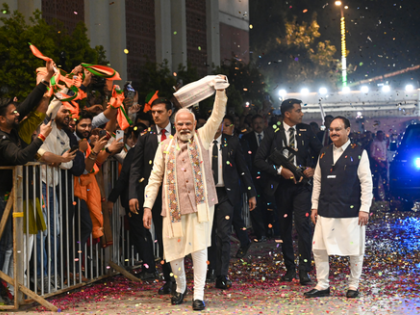
The NDA secured a resounding victory, winning 202 of the 243 Assembly seats.
BJP won 89 seats, JD-U won 85 seats, LJP (Ram Vilas) led by Chirag Paswan won 19 seats, Hindustani Awam Morcha (HAM) led by Jitan Ram Manjhi won five seats, and Rashtriya Lok Morcha led by Upendra Kushwaha won four seats.
The results proved to be a major setback for the Grand Alliance, which was reduced to just 35 seats. Of these, RJD won 25 seats, Congress won six seats, CPI-ML secured two seats, the Indian Inclusive Party (IIP) and CPI-M won one seat each.
Outside the two major alliances, All India Majlis-e-Iteehadul Muslimeen won five seats, while the Bahujan Samaj Party secured one seat.
With this sweeping mandate, Nitish Kumar returned to power once again as Chief Minister of Bihar, reinforcing NDA unity and marking one of the most decisive victories in the state's recent political history.
Disclaimer: This post has been auto-published from an agency feed without any modifications to the text and has not been reviewed by an editor
Open in app