
Mamata Banerjee: An astute, unpredictable politician, enigma to many
By IANS | Updated: April 14, 2026 21:50 IST2026-04-14T21:47:20+5:302026-04-14T21:50:13+5:30



New Delhi, April 14 In the run-up to the 2006 West Bengal Assembly election, it appeared that Mamata ...
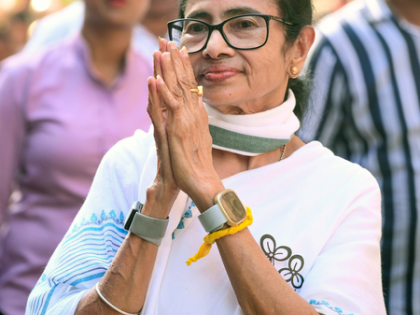
Mamata Banerjee: An astute, unpredictable politician, enigma to many
New Delhi, April 14 In the run-up to the 2006 West Bengal Assembly election, it appeared that Mamata Banerjee would wrest power from the communists in the state, even if not with an overwhelming margin. But, she could not. Voter’s turnout was recorded at 84.52 per cent in 2006, the highest in the state and the Left citadel fortified itself, sweeping 233 of the 294 Assembly seats.
Mamata’s Trinamool Congress lost half of the 60 seats it had won earlier in 2001. But being someone not to say never again, she continued her tirade, and found her gambit in the Left Front government’s ambitious industrialisation plans – in Singur and Nandigram.
Meanwhile, she started moving away from the Bharatiya Janata Party (BJP), and started warming up to the Congress – the party she broke out of to build Trinamool Congress. In 1998, frustrated with Congress’s inability to challenge the Left, she founded the Trinamool Congress. Her new party became the spearhead of resistance, mobilising street protests and steadily eroding the Left’s dominance.
In 2011, she turned nemesis to a communist leader who was then the state’s poster boy of reform, Buddhadeb Bhattacharjee. The red bastion crumbled. Mamata’s protests linked use of land for agriculture over industrialisation, and touched an emotive chord that resonated with a state that is largely agrarian.
Will 2026 be a repeat – with different players – of the referendum exactly two decades ago, or that of 2011? That is a question to which there is no simple answer till the mandate comes out on May 4.
Mamata’s systematic and sustained campaign of 2006-2007 is said to have led to bigger industries staying off West Bengal, though some small and medium enterprises did come. But that did not deter the new Chief Minister visibly as she continued to hold business meets and seek investment.
Meanwhile, Mamata evolved as a generous patron of sports and festivities, loosened government purse strings for “beneficial schemes” in health, for women and minorities, that helped strengthen her support base.
The first shock for the Trinamool government was perhaps the outcome of the 2019 Lok Sabha election, when the BJP consolidated itself by winning 18 of the states 42 Parliamentary seats – an addition of 16 to its earlier kitty. It also bettered its vote share to its highest, almost doubling to a near 41 per cent to the Trinamool’s around 44 per cent that year.
And in the 2021 Assembly election, the BJP became the state’s principal Opposition with 77 of a total of 294 seats, even as once-ruling Left and the Congress found themselves unrepresented in the Vidhan Sabha. In that election, the BJP scored about 38 per cent vote share to the Trinamool’s 48.
In the subsequent Lok Sabha election of 2024, the BJP could win 12 seats and 39 per cent share of the mandate, as the Trinamool got 29 seats with 46 per cent votes. For the BJP, a division of minority votes in 2026 Assembly poll in a multi-directional contest partly holds the key. Among other issues are corruption charges against those in power and the law-and-order situation, and more, the recent revision of electoral rolls.
But Mamata is an astute politician. A strong person, yet exhibiting vulnerability; a leader in whom followers repose faith, look up as a person who cares. She remains unpredictable, an enigma to many. She has walked the political path with both the BJP as well as the Congress in her rise to power.
Of late, she has been choosing to contest alone, without alliances, which have brought favorable results – till now. She has consistently defied predictions, reinvented herself, and consolidated her position as West Bengal’s most dominant leader.
The journey started in the 1970s, when she famously climbed onto Jayaprakash Narayan’s car when he was in then-Calcutta in the buildup to the anti-Emergency movement. This act of defiance symbolised her style, later becoming her hallmark. She has fought with her head bandaged, and recently, campaigned with her foot in a cast.
Disclaimer: This post has been auto-published from an agency feed without any modifications to the text and has not been reviewed by an editor
Open in app