
Number of poor getting subsidised LPG under PMUY scheme touches 10.35 crore in 2025
By IANS | Updated: December 26, 2025 13:50 IST2025-12-26T13:47:05+5:302025-12-26T13:50:10+5:30


New Delhi, Dec 26 The number of beneficiaries under the government’s flagship Pradhan Mantri Ujjwala Yojana, aimed to ...
Number of poor getting subsidised LPG under PMUY scheme touches 10.35 crore in 2025
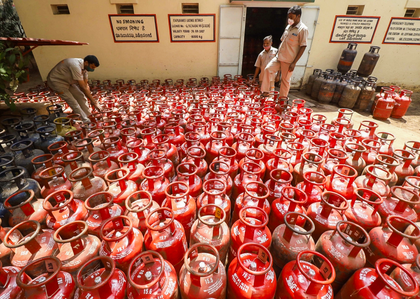
New Delhi, Dec 26 The number of beneficiaries under the government’s flagship Pradhan Mantri Ujjwala Yojana, aimed to ensure universal access to clean cooking fuel, touched 10.35 crore as on December 1, 2025, according to Ministry of Petroleum and Natural Gas on Friday.
Affordability of LPG was supported through a targeted subsidy of Rs 300 per 14.2 kg cylinder for up to nine refills per year for PMUY beneficiaries. This intervention resulted in a steady rise in LPG consumption. Average per capita consumption increased from about three refills in 2019-20 to 4.47 refills in FY 2024-25 and further to a pro-rated level of about 4.85 refills per annum during FY 2025-26, indicating sustained adoption of clean cooking fuel.
To clear pending applications and achieve saturation of LPG access, the government approved the release of 25 lakh additional LPG connections during FY 2025-26. Subsidy targeting and transparency was improved with the acceleration of Aadhaar authentication. As on December 1, 2025, biometric authentication covered 71 per cent of PMUY consumers and 62 per cent of non-PMUY consumers, the statement said.
Consumer safety was strengthened through the nationwide 'Basic Safety Check' campaign. More than 12.12 crore free safety inspections were conducted at customer premises, and over 4.65 crore LPG hoses were replaced at discounted rates, significantly enhancing awareness and safety standards in domestic LPG usage.
The Ministry also focused on strengthening petroleum marketing infrastructure. Over 90,000 retail outlets were enabled with digital payment facilities, supported by more than 2.71 lakh POS terminals.
Electric mobility infrastructure expanded rapidly during the year. Under the FAME-II scheme, 8,932 EV charging stations were installed at retail outlets, while Oil Marketing Companies (OMCs) additionally set up over 18,500 charging stations from their own resources. The 'APNA GHAR' initiative progressed with more than 500 wayside amenities established for truckers, improving road safety and supporting rural employment, the statement pointed out.
Public Sector OMCs are setting up 4,000 energy stations during 2024-25 to 2028-29 along major corridors and other feasible locations. These stations are being developed as integrated mobility hubs offering conventional fuels such as petrol and diesel along with alternative fuels including biofuels, CNG and electric vehicle charging facilities. As on November 1, 2025, 1,064 energy stations have been set up across the country.
Significant progress was made in expanding the gas-based economy. The length of operational natural gas pipelines in the country has increased from 15,340 kms in 2014 to 25,429 kms (as on June 2025), with another 10,459 kms under execution as part of the national gas grid.
City Gas Distribution coverage expanded to 307 geographical areas. As on September 2025, PNG domestic connections reached about 1.57 crore and CNG stations increased to over 8,400.
Under the SATAT initiative, as on November 1, 2025, over 130 compressed bio gas plants have been commissioned, with several more under construction. Mandatory blending obligations for CBG in CNG and PNG segments commenced from FY 2025-26, supported by financial assistance for pipeline connectivity and biomass aggregation.
Biofuels witnessed major gains during the year. Ethanol blending in petrol reached an average of 19.24 per cent in ESY 2024-25, with cumulative foreign exchange savings exceeding Rs 1.55 lakh crore and substantial carbon emission reductions.
The upstream sector also underwent significant reforms. Under the Hydrocarbon Exploration Licensing Policy, 172 blocks covering more than 3.78 lakh sq km were awarded, attracting committed investments of about $4.36 billion. Exploration activity intensified through seismic surveys, drilling programmes and government-funded initiatives such as 'Mission Anveshan'.
Through sustained policy reforms, infrastructure expansion and clean energy initiatives, the Ministry of Petroleum & Natural Gas made significant progress in strengthening energy access, affordability, sustainability and security during 2025, supporting India’s journey towards a resilient and inclusive energy future, the statement added.
Disclaimer: This post has been auto-published from an agency feed without any modifications to the text and has not been reviewed by an editor
Open in app