
SC orders phased introduction of Rajasthani in schools across state
By IANS | Updated: May 12, 2026 19:20 IST2026-05-12T19:19:08+5:302026-05-12T19:20:07+5:30



New Delhi, May 12 The Supreme Court on Tuesday directed the Rajasthan government to formulate a comprehensive policy ...
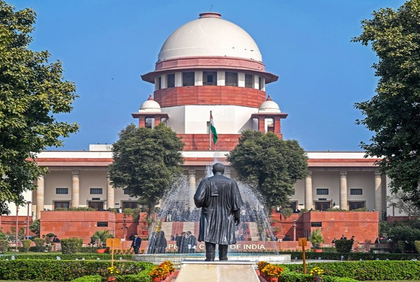
SC orders phased introduction of Rajasthani in schools across state
New Delhi, May 12 The Supreme Court on Tuesday directed the Rajasthan government to formulate a comprehensive policy for implementing mother tongue-based education and to progressively introduce Rajasthani as a subject in schools across the state, observing that the ability to understand and be understood in one’s own language is an “existential right” intrinsically linked to meaningful participation in society.
A Bench of Justices Vikram Nath and Sandeep Mehta set aside a Rajasthan High Court order dismissing a public interest litigation seeking inclusion of the Rajasthani language in the Rajasthan Eligibility Examination for Teachers (REET), 2021 syllabus, and directions for imparting education in Rajasthani or relevant local languages.
“The ability to understand and be understood in one’s own language is not a matter of convenience, but a matter of existential rights, for comprehension must necessarily precede meaningful participation in society and day-to-day life activities,” the apex court said.
The Justice Mehta-authored judgment said language is “the very essence of an individual” and accessibility of language assumes “constitutional significance” in a society governed by law.
It added that the question of language in education goes beyond administrative considerations and strikes “at the very core of inclusivity, identity, and meaningful access to the learning process”.
While noting that the specific relief relating to REET-2021 had become infructuous as the recruitment process had already concluded, the Supreme Court held that the broader constitutional questions concerning language in education and public employment required consideration.
“Education is the transformative force, capable of uplifting an individual from adverse circumstances and elevating him to the highest realms of personal, social, and economic development,” Justice Nath-led observed.
It said the constitutional framework recognises that quality education is inseparably linked to the medium through which it is imparted.
“Instruction that cannot be adequately grasped by the students due to language barriers or unfamiliar mediums of instruction cannot, in any meaningful sense, be regarded as quality education,” the top court said.
Referring to Article 21A, Article 19(1)(a), Article 350A of the Constitution, the Right of Children to Free and Compulsory Education Act, 2009, and the National Education Policy (NEP), 2020, the Supreme Court stressed that education must be “intelligible, inclusive, and empowering”.
It reiterated that the right to freedom of speech and expression includes the right to receive education in a language that is meaningful and comprehensible to the child.
“Viewed through this constitutional lens, it follows that education, being a primary vehicle for transmission of knowledge, must, to the extent practicable, be imparted in a language that the child understands best,” the judgment said.
The Justice Nath-led Bench also expressed concern about a “substantial deficit” in the implementation of mother-tongue-based education policies at the ground level.
“While frameworks, schemes, and policies continue to be announced with much fanfare and panache, their absence in the lived experience of the child renders the entire exercise hollow. A right that exists only on paper, without corresponding administrative will or implementation, is in effect no right at all,” it said.
Criticising the Rajasthan government’s stand that only languages included in the Eighth Schedule of the Constitution are taught in government primary and upper primary schools, the apex court termed the approach “myopic” and “pedantic”.
“It has been urged on behalf of the State that only those languages that are enumerated in the Eighth Schedule to the Constitution are presently taught as subjects in Government Primary and Upper Primary Schools,” the judgment recorded, adding that such a stance effectively sidesteps the constitutional imperative of meaningful access to education.
It highlighted that Rajasthani is already being taught in universities across Rajasthan, including the University of Rajasthan, Jai Narain Vyas University, and Maharaja Ganga Singh University.
“The academic recognition of Rajasthani at the higher educational level itself belies all suggestions that the language lacks institutional or pedagogical acceptance,” the top court said.
Directing the Rajasthan government to take “affirmative and time-bound steps”, the Supreme Court ordered the state to progressively facilitate the adoption of Rajasthani as a medium of instruction, initially at foundational and preparatory stages and later at higher levels.
It further directed the state government to introduce Rajasthani as a subject in all government and private schools in a phased manner consistent with constitutional principles and the NEP, 2020.
“Constitutional guarantees and policy declarations, particularly those bearing upon access to meaningful and inclusive education, cannot be permitted to remain dormant for want of executive action,” the judgment said.
The Rajasthan government has been directed to file a compliance affidavit by September 25, 2026, and the matter will next be heard on September 30.
--IANS
Disclaimer: This post has been auto-published from an agency feed without any modifications to the text and has not been reviewed by an editor
Open in app