
Solar microgrids illuminate remote Tripura villages, bring clean water to over 11,900 families
By IANS | Updated: May 11, 2026 00:00 IST2026-05-10T23:56:11+5:302026-05-11T00:00:16+5:30



Agartala, May 10 Tripura Power Minister Ratan Lal Nath on Sunday said that the Power Department, in collaboration ...
Solar microgrids illuminate remote Tripura villages, bring clean water to over 11,900 families
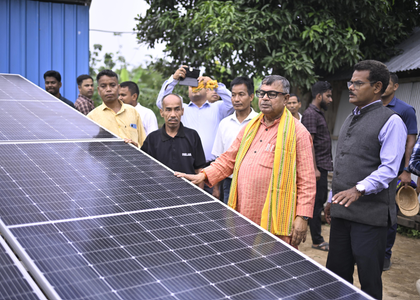
Agartala, May 10 Tripura Power Minister Ratan Lal Nath on Sunday said that the Power Department, in collaboration with Tripura Renewable Energy Development Agency (TREDA), is working extensively to provide electricity and clean drinking water through solar microgrids in remote hilly areas of Tripura where conventional electricity supply through poles and transmission lines is not feasible.
The minister made the remarks while inaugurating a solar microgrid project and a community-based solar purified drinking water plant at Khabaksa Kami village under Teliamura in the Baramura hill range of Khowai district.
Speaking at the programme, Nath said that 42 families belonging to different communities reside in the village and had long been facing severe electricity-related problems due to the difficult terrain and lack of infrastructure.
“Since it is not possible to provide conventional electricity connections in many such remote hilly locations like Khabaksa Kami village because of geographical and technical challenges, we are ensuring electricity supply through solar microgrids,” the minister said.
He stated that the government is also installing solar-powered street lights in these areas under the PM-DevINE (Prime Minister's Development Initiative for North Eastern Region) scheme to improve safety and connectivity after sunset. “Now the villagers will no longer face electricity-related problems. Each family is being provided with three lights and mobile charging facilities. Along with Khabaksa Kami Para, electricity has been provided through solar microgrids in 347 other remote habitations across the state with the support of TREDA,” Nath added.
According to the minister, the newly inaugurated project at Khabaksa Kami Para alone will benefit 42 families, while a total of 11,933 families across Tripura have already been covered under the solar microgrid initiative.
He further said that the state government is prioritising renewable energy solutions in locations is where extending electric poles and live transmission lines is practically impossible.
“Wherever conventional power infrastructure cannot reach, we are introducing solar microgrids. In addition to electricity, we are also setting up community-based purified drinking water facilities powered by solar energy so that people living in remote villages can access safe and clean drinking water,” he said.
Highlighting the government’s broader development plans for the area, Nath said efforts would also be made to improve the economic condition of local residents and encourage self-reliance. “It is our collective responsibility to stand beside the people living in these remote areas. To support their livelihood and make them self-reliant, we plan to distribute saplings of mango, jackfruit, lemon and other fruit-bearing trees. We will also discuss additional welfare measures with the Director of Agriculture,” he said.
The minister noted that the availability of solar-powered electricity has already started transforming daily life in remote villages by improving education, communication, livelihood opportunities and overall quality of life.
“Students can now study at night because homes are illuminated with solar power instead of kerosene lamps. Mobile charging facilities and access to television are helping villagers stay connected with information and social developments. Traditional bamboo craft and weaving activities can continue after dark, which is boosting livelihoods and income opportunities,” Nath said.
He added that the availability of electricity is also helping small businesses remain operational during evening hours, strengthening the rural economy while improving mobility and social interaction after sunset.
Speaking about the progress of the drinking water initiative, the minister informed that under the Community-Based Solar Purified Drinking Water Plant project, a target of establishing 80 units had been set by the government. “Out of the targeted 80 units, work on 37 projects has already been completed, while construction and installation work for another 38 units is currently in progress,” he added.
Disclaimer: This post has been auto-published from an agency feed without any modifications to the text and has not been reviewed by an editor
Open in app