
WB SIR: ‘Why Only West Bengal?’ Questions Mamata Banerjee; Challenges EC Over Electoral Roll Revision in SC (Watch Video)
By Lokmat Times Desk | Updated: February 4, 2026 16:06 IST2026-02-04T16:05:34+5:302026-02-04T16:06:26+5:30



In an unusual intervention by a serving Chief Minister, Mamata Banerjee informed the Supreme Court on Wednesday that the ...
WB SIR: ‘Why Only West Bengal?’ Questions Mamata Banerjee; Challenges EC Over Electoral Roll Revision in SC (Watch Video)
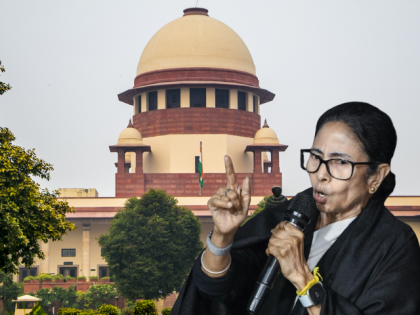
In an unusual intervention by a serving Chief Minister, Mamata Banerjee informed the Supreme Court on Wednesday that the ongoing Special Intensive Revision (SIR) of electoral rolls in West Bengal was allegedly structured to single out her state ahead of the forthcoming Assembly elections. She asserted that the exercise had caused extreme pressure, leading to the deaths of more than 150 individuals. Among them was a Booth Level Officer who, she claimed, succumbed to severe stress caused by instructions issued by the Chief Electoral Officer. Banerjee argued that the process had created fear, confusion, and administrative coercion across districts, severely impacting electoral workers and ordinary citizens alike.
The Trinamool Congress chief, who reached New Delhi three days earlier to intensify her confrontation with the Election Commission of India, presented her arguments before a bench consisting of Chief Justice of India Surya Kant, along with Justices Joymalya Bagchi and Vipul Pancholi. The bench was hearing a series of petitions questioning the legality and implementation of the SIR exercise in West Bengal. Banerjee personally appeared to highlight what she described as systematic irregularities and constitutional violations. She maintained that the revision process undermined democratic principles and disproportionately affected vulnerable voters, demanding urgent judicial scrutiny to prevent irreversible damage to the electoral framework in the state.
While addressing the bench, the Chief Minister questioned the rationale behind focusing exclusively on West Bengal. “Why Bengal? Why not Assam or other northeastern states? The Election Commission is only targeting Bengal to bulldoze people of the state,” she said, appealing to the Supreme Court to step in to protect democratic rights. Banerjee alleged that the state was being deliberately targeted ahead of elections to influence outcomes. She claimed the selective implementation reflected political bias rather than administrative necessity, arguing that similar revisions were absent elsewhere. According to her, the exercise created uncertainty among voters and risked disenfranchising lakhs without due process or transparency.
Chief Minister Mamata Banerjee presented her stand on SIR in the Supreme Court with remarkable courage and strength.
— Teja Yadav (@Tejaydv44) February 4, 2026
No fear, no pressure—only truth and determination.
Mamata Banerjee is a lioness ...! pic.twitter.com/TL5sxOI7sG
Continuing her submissions, Banerjee stated that the first phase of the SIR exercise had resulted in the deletion of nearly 58 lakh names from the electoral rolls. She contended that many of these deletions were carried out without providing affected voters an opportunity to file appeals using Form 6. According to her, this violated established electoral safeguards and denied citizens their right to be heard. Banerjee argued that the absence of proper appeal mechanisms indicated a predetermined intent to remove names rather than correct records. She maintained that such large-scale deletions, executed hastily, raised serious constitutional and procedural concerns requiring immediate intervention.
She further alleged that the deletions were largely executed by micro-observers who were reportedly deputed from BJP-ruled states, while local election officials were deliberately sidelined. Banerjee claimed that these observers rejected legitimate documents, including domicile certificates and other government-issued identification, without justification. According to her, the sidelining of local staff weakened accountability and familiarity with ground realities. She argued that the rejection of valid proofs suggested arbitrary decision-making and political interference. The Chief Minister asserted that such practices compromised the neutrality of the electoral process and eroded public trust in constitutional institutions meant to safeguard democracy.
Pointing to structural flaws, Banerjee said the SIR exercise appeared primarily designed to facilitate deletions rather than corrections. She explained that even minor changes were being treated as discrepancies. Situations such as a woman changing her surname after marriage or shifting residence to her in-laws’ home were flagged as mismatches. Similarly, individuals relocating for employment were categorised under “logical discrepancies” and faced possible removal from electoral rolls. According to Banerjee, these rigid interpretations ignored social realities and disproportionately affected women and migrant workers, thereby increasing the risk of unjust disenfranchisement across large sections of the population.
Chief Minister Mamata Banerjee 🔥appeared as a lawyer in the Supreme Court today and presented arguments on the SIR issue, which the Supreme Court heard and issued a notice to the Election Commission.
— Shruti Dhore (@ShrutiDhore) February 4, 2026
This is a major victory for Mamata DIDI in the SC ✊pic.twitter.com/WVkKFVXM7T
Criticising the timing of the revision, Banerjee questioned the urgency behind the accelerated schedule. “After 24 years, what was the hurry to complete in four months. What could have been done in two years? Notices were issued during harvest and Puja seasons when people were away from their homes.” She argued that the compressed timeline made meaningful participation impossible. According to her, issuing notices during peak agricultural and festival periods ensured many citizens were unavailable to respond, further increasing the likelihood of wrongful deletions and administrative errors during the process.
Banerjee also expressed dissatisfaction with the Election Commission’s alleged silence despite repeated communication attempts. “Lawyers always fight for the case when everything is finished. Justice is crying behind the doors. I have written six letters to the ECI, but there has been no reply,” she said. She added, “I am a less important person, a bonded labour, but I am not fighting for my party. I am an ordinary person seeking justice.” She maintained that her intervention was driven by concern for citizens rather than political interest, urging the court to acknowledge the human impact of the exercise.
Concluding her arguments, Banerjee sharply criticised the Election Commission, referring to it as the 'WhatsApp Commission.' “The Election Commission, sorry, the WhatsApp Commission is doing all this. People’s names are being deleted. Bengal is being targeted,” she said.
In #SupremeCourt, Mamata Banerjee calls Election Commission "WhatsApp Commission", says ECI was issuing informal orders through WhatsApp.#MamataBanerjee#SIRhttps://t.co/wnMOxj9xCc
— Live Law (@LiveLawIndia) February 4, 2026
After hearing her plea, the Supreme Court adjourned the matter and issued a notice to the Election Commission, directing it to submit its response by February 10. The court’s direction marked the next step in judicial scrutiny of the controversial electoral roll revision exercise in West Bengal.
Open in app