
Why has the Fire of Rebellion Erupted in Iran
By Vijay Darda | Updated: January 5, 2026 06:11 IST2026-01-05T06:08:01+5:302026-01-05T06:11:42+5:30



Will the plan to uproot Khamenei succeed? Will the Shah regain authority?
Why has the Fire of Rebellion Erupted in Iran
When a regime employs harsh measures against its citizens, it creates openings for external actors to exploit the instability for strategic advantage. Iran’s current situation may exemplify this dynamic.
For years, embers of discontent have been simmering beneath the surface among people seeking greater freedom in the Islamic Republic of Iran. But how did this fire suddenly flare up? Is inflation and unemployment alone at the root of this popular uprising? Or is there a larger plan to overthrow the Khamenei government, which has trampled human rights and women’s freedom under military boots?
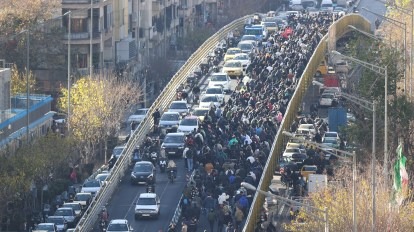
The manner in which protests are unfolding — arson, attacks on police stations, and attempts by demonstrators to storm military bases — shows just how intense this uprising is. Thousands of people have been arrested, and several protesters have been killed in police firing. What began in the city of Mashhad has now spread across Iran. This is the first time since the 2009 presidential election that public anger has posed a direct threat to the regime.
Meanwhile, listen carefully to the slogans being raised by the protesters. They are not only demanding the dismissal of the government, but also criticising foreign policy and even calling for the death of Iran’s supreme leader Ayatollah Ali Khamenei, who keeps issuing repeated warnings to the United States.
In this context, consider the statement of US President Donald Trump as well. Trump says: “Iran is failing at every level despite the terrible deal made with them by the Obama Administration. The great Iranian people have been repressed for many years. They are hungry for food & for freedom. Along with human rights, the wealth of Iran is being looted. TIME FOR CHANGE!.”
A similar tone has also been struck by Reza Pahlavi, son of Iran’s former ruler Shah Mohammad Reza Pahlavi. Reza has said that the present Islamic Republic is collapsing and that the time has come to reclaim the original Iran. He is repeatedly calling upon the people to take to the streets and participate in a national revolution. At this point, it is important to understand the significance of Reza Pahlavi, who lives in the United States, and how his father, Shah Mohammad Reza Pahlavi, came to power in Iran.
In 1951, Mohammad Mosaddegh, a National Front candidate and a lawyer by profession, was democratically elected and became Prime Minister. He was a remarkably courageous leader. At that time, Iran’s oil industry was controlled by British companies, which appropriated most of the profits. Mosaddegh took a bold decision and nationalised the oil industry. It was inevitable that Western powers would be angered. Britain’s intelligence agency MI6 and the US intelligence agency CIA engineered a plot that led to a coup in Iran in 1953, after which Western powers installed Shah Mohammad Reza Pahlavi — whose family had ruled earlier — back in power. The Shah handed over a substantial share of Iranian oil to American companies. These are not mere hearsay; in 2013, the CIA officially acknowledged its role in the 1953 coup.
It must also be mentioned here that Iran made significant progress during the Shah’s era. He pushed the country ahead along the path of modernisation and granted more freedom to women. Iran, at that time, resembled a European society in many respects. However, this closeness to the United States was unacceptable to hardliners and to powers such as the Soviet Union.
In 1979, the Islamic Revolution took place in Iran. Not only did the Pahlavi rule come to an end, but a group of Iranian students also seized the US Embassy on November 4, 1979, holding 52 Americans hostage for 444 days. This became a matter of grave humiliation for the superpower United States. Ayatollah Khomeini, who came to power, sounded the bugle against America. The bitterness that entered US–Iran relations has continued since then. The current supreme leader Khamenei, is following the same path as Khomeini.
Iran has come very close to developing a nuclear bomb, and Western powers may do anything to prevent this. Several Iranian nuclear scientists have been assassinated by Israel. Just last year, the United States targeted three alleged Iranian nuclear sites. Despite this, the current regime remains adamant about pursuing the bomb. As a result, the great powers increasingly see a permanent solution in eliminating Khamenei’s rule itself.
It should be remembered that exploiting internal dissent within a nation as a diplomatic weapon is an age-old practice. It is quite possible that such factors are also at work behind the current popular uprising. There is no doubt that several powers including the United States, Britain, Israel, and Russia have their own agendas in Iran.
At present, the entire world is waiting to see whether Khamenei plays on the front foot or goes into defence in retreat. Whether the stumps stay intact is to be seen!
Before I conclude I am deeply pained by the deaths of over a dozen people due to contaminated water in Indore, a city that wears the crown of being the cleanest in the country. What pains me even more is how the system could be so negligent that polluted water reached people’s homes through taps. And the shameful language used by the responsible leadership afterward is even more distressing. Does human life have no value?
The author is the chairman, Editorial Board of Lokmat Media and former member of Rajya Sabha.
Open in app
