
Corporate Philanthropy is Rewiring Development in India’s Smaller Towns
By PNN | Updated: April 10, 2026 18:05 IST2026-04-10T23:33:32+5:302026-04-10T18:05:07+5:30



New Delhi [India], April 10: For much of the past decade, corporate social responsibility spending in India has followed ...
Corporate Philanthropy is Rewiring Development in India’s Smaller Towns
New Delhi [India], April 10: For much of the past decade, corporate social responsibility spending in India has followed a familiar map. Funds have flowed into large metropolitan districts and their surrounding urban clusters, reflecting where companies are headquartered, where implementation capacity is strongest, and where programme outcomes are easier to document. Smaller towns and industrial districts, despite hosting significant economic activity, have typically attracted a smaller share of corporate social investment.
CSR's Next Act, a report by Sattva Consulting, examines how this pattern is beginning to shift. Drawing on company disclosures and district-level spending data, the study tracks changes in where CSR funds are going and how programmes are being structured. It points to a gradual redistribution of corporate philanthropy towards Tier-2 cities, industrial hubs and selected high-need regions, even as urban concentration remains a defining feature of the ecosystem.
India's CSR law, introduced under the Companies Act, 2013, requires eligible companies to spend at least 2 per cent of their average net profits on social development. Over time, this mandate has created a sizeable pool of capital for social programmes. More than 4,000 companies together account for nearly ₹30,000 crore in CSR spending annually, making corporate philanthropy a significant contributor to development financing.
Geography of CSR
Despite this scale, the distribution of funds has historically been uneven. For years, Tier-1 cities absorbed close to one-third of CSR inflows. Companies often directed funds toward locations where they had administrative presence or where credible implementing partners were already established. The need to track outputs and report measurable outcomes also influenced this pattern, reinforcing the concentration of CSR activity in urban districts with stronger institutional infrastructure.
Recent data indicates that this pattern is changing. CSR spending in Tier-2 city clusters has grown by 55 per cent over the last three years, while allocations to industrial hub districts have increased sharply. Cities such as Madurai, Varanasi, Mysuru and Vadodara have recorded substantial increases in CSR inflows, reflecting a widening geographic spread of corporate philanthropy.
Industrial districts now account for nearly one-fifth of district-level CSR spending. CSR inflows into these regions grew by 120 per cent between FY22 and FY24, significantly outpacing the overall 30 per cent growth in CSR allocations during the same period. Industrial clusters now account for 7.4 per cent of total CSR spend, up from 4.4 per cent two years earlier. Districts such as Jharsuguda in Odisha received about ₹549 crore in CSR inflows, while Raigarh, Jamnagar and Ballari each attracted between ₹295 crore and ₹402 crore. The concentration of funds in these locations reflects the strong presence of metals, mining and energy companies deploying CSR around operational sites.
The localisation of CSR activity is also reflected in project design. About 85 per cent of CSR initiatives between FY22 and FY24 were focused on a single district and accounted for roughly two-thirds of total CSR spending. This shift toward district-specific interventions is associated with greater emphasis on place-based implementation and programme continuity.
At the same time, the relationship between CSR flows and development indicators remains uneven. Nearly three-quarters of district-focused CSR spending is concentrated in fewer than 200 districts, many of which have relatively low multidimensional poverty levels. High-poverty districts continue to receive a smaller share of corporate funding. This suggests that while geographic diversification is underway, alignment with indicators of socio-economic need is still limited.

Reaching deeper into India's districts
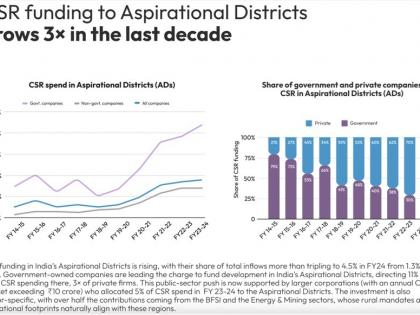
CSR allocations to Aspirational Districts have increased steadily over the past decade. Their share of total CSR inflows has risen more than threefold, from 1.3 per cent in FY15 to 4.5 per cent in FY24. Government-owned companies have played a leading role in this shift, directing about 11 per cent of their CSR spending to these districts, nearly three times the share allocated by private firms. Larger corporations with annual CSR budgets above ₹10 crore have also begun expanding investments in these regions, accounting for around 5 per cent of their CSR deployment in FY24. Sectorally, over half of the funding into Aspirational Districts has come from BFSI and energy and mining companies whose operational footprints are closely tied to rural geographies.
Company size continues to influence where funds are deployed. Firms with smaller CSR budgets tend to concentrate spending in their home states or headquarters regions. Larger corporations distribute funds across multiple states and districts, reflecting broader operational footprints. Across budget categories, a significant portion of CSR allocations is still directed toward states where companies are headquartered.
The report also notes changes in how CSR programmes are implemented. While non-governmental organisations remain key partners, specialised institutions such as universities, hospitals, incubators and corporate foundations are receiving a growing share of CSR funding. In FY24, nearly one-fifth of implementation funding was channelled through such institutions, indicating a gradual diversification of programme delivery mechanisms.
Taken together, the data points to an evolving CSR landscape in which corporate philanthropy is expanding beyond metropolitan centres into smaller towns and industrial regions. The extent to which this shift continues, and how closely CSR allocations track indicators of development need, will influence the role of corporate funding in shaping regional development outcomes in the coming years.
Disclaimer: This post has been auto-published from an agency feed without any modifications to the text and has not been reviewed by an editor
Open in app