
Poor families will get keys to their own flats in New Year: Delhi CM
By IANS | Updated: December 29, 2025 20:05 IST2025-12-29T20:01:52+5:302025-12-29T20:05:11+5:30



New Delhi, Dec 29 In welcome news for 2,500 families belonging to the Economically Weaker Sections (EWS), Delhi ...
Poor families will get keys to their own flats in New Year: Delhi CM
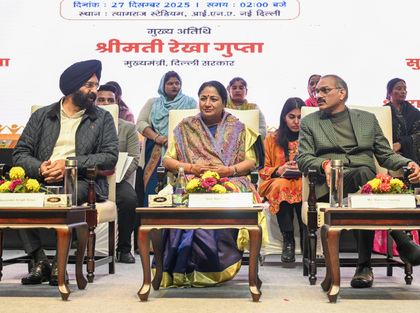
New Delhi, Dec 29 In welcome news for 2,500 families belonging to the Economically Weaker Sections (EWS), Delhi Chief Minister Rekha Gupta announced on Monday that citizens will start getting keys to their own flat at Savda Ghevra in the northwestern parts of the city in the New Year.
The government’s push to allot the ready-to-move-in dwelling units to eligible beneficiaries comes as part of CM Gupta’s efforts to improve the quality of life and ensure ease of living in the city for the poor, she said.
The Chief Minister said the government’s thinking is not limited to providing permanent houses alone; rather, the aim is to settle poor families in colonies where all basic facilities related to education, healthcare, sanitation, water supply, green spaces and livelihoods are available together.
She hit out at the previous governments in the city for not allotting keys to the flats to poor beneficiaries.
The Chief Minister said that the Savda Ghevra EWS residential colony has been developed over approximately 37.81 acres of land.
Between 2012 and 2018-2020, a total of 7,620 residential units were constructed here, of which 6,476 flats are currently vacant. However, previous governments showed little interest in settling poor families in this colony, due to which many flats are now in need of repair, she said.
She said the Delhi government is steadily moving forward with its resolve to provide not just a roof, but a dignified and well-facilitated life to citizens belonging to the Economically Weaker Sections (EWS) of the capital.
In this direction, community facilities are being developed in existing EWS residential colonies of the Delhi Urban Shelter Improvement Board (DUSIB), she said.
She said the development of basic and social infrastructure in large colonies built for the poor, such as Savda Ghevra, remains among the government’s highest priorities. The Chief Minister stated that from the coming year, eligible poor families will begin receiving allotment of flats.
The colony has a 100 per cent sewerage network, which is considered a significant achievement from the perspective of basic urban infrastructure.
According to the Chief Minister, keeping in view green spaces and environmental balance, 39 residential parks have been developed in Savda Ghevra, covering a total area of over 22,000 square metres.
In addition, two underground water tanks, booster stations and overhead water tanks have been provided to ensure a sustainable and uninterrupted water supply. For solid waste management, four collection points have been constructed, including facilities for waste segregation.
The Chief Minister said that cleanliness, greenery and water management are the lifelines of any colony, and the Government is ensuring that there is no shortfall in these facilities at Savda Ghevra.
Several important facilities in the colony are still under construction. Of the two proposed primary schools, one has been completed. Similarly, a dispensary or hospital has been proposed.
Facilities linked to local trade and employment, such as a local shopping centre, service market, milk booth, and three-wheeler and taxi stands, are also in the process of development.
The Chief Minister clearly stated that in the absence of such facilities, residents are compelled to travel long distances for daily needs, which the Government cannot accept.
Within a radius of 1.5 kilometres of Savda Ghevra, facilities such as bus stops, community halls, a post office, health centres, schools, Anganwadi centres and Bastī Vikas Kendras are already available.
Within a 3-kilometre radius, metro stations, police posts, police stations, and additional educational and healthcare institutions are accessible.
The Chief Minister said that there is a need to integrate these facilities more effectively with the colony’s internal infrastructure so that residents can derive their full benefit.
--IANS
rch/dan
Disclaimer: This post has been auto-published from an agency feed without any modifications to the text and has not been reviewed by an editor
Open in app