
Countdown for new year starts in Nepal with commencement of week-long Biska Jatra
By ANI | Updated: April 10, 2026 22:35 IST2026-04-11T04:03:52+5:302026-04-10T22:35:07+5:30



Bhaktapur [Nepal], April 10 : The ancient Taumadhi Square of Bhaktapur was full of people on Friday, with revellers ...
Countdown for new year starts in Nepal with commencement of week-long Biska Jatra
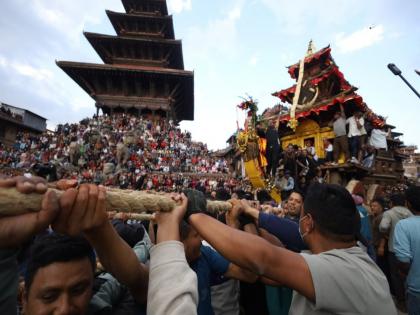
Bhaktapur [Nepal], April 10 : The ancient Taumadhi Square of Bhaktapur was full of people on Friday, with revellers and devotees coming to watch the Biska Jatra kick-starting the countdown for the Nepali New Year.
As per the folklore, the Biska Jatra starts the countdown for the Nepali New Year, which falls on Tuesday this year.

One of the popular religious festival of the Kathmandu Valley, the festival starts with the ascension of Lord Bhairab onto chariot built infront of the Nayatapola temple, the tallest temple in Nepal. The three-story chariot made of wood in the pagoda style is pushed and pulled around the settlements with the statues of Bhairavnath and Betal as a part of this festival.
Two group of locals struggle to pull on the chariot to either of their side amid show of strength which has been followed since ages. This festival of cultural and historical importance is celebrated for nine days and eight nights.
"The chariot after the ascension of the god Bhairab will be pulled from either of the side (like tug-of-war), it is divided as Tallo (Lower) and Mathillo (Upper) tole (area). As per the legends either of the side which can pull the chariot to their area is believed to have more prosperous new year," Rabindra Kumar Shrestha, Secretary of the Taumadhi Club, which has been overseeing the organization of the annual celebration, told ANI.

On the first day, Lord Bhairab (Bhaila Kha:) is ascended on a chariot and is toured round the city. It is pulled by two groups one on the upper side of Nyatapola Temple and other on the lower side, the tug of war continues for hours and days. It finally is rested in front of temple near the Nyatapola and is worshipped by all.
Believed to have started from Malla Dynasty, Biska Jatra formally starts four days before the start of Nepali New Year.
"The chariot is pulled for 8 nights and 9 days. On the first day it is pulled around and on is taken to the lower area of the (taumadhi) square. It is rested for the two days and on the new year day it is pulled to the upper area and again is rested for another two days. This year it will be celebrated till the 5th of Baisakh," Shivaram Bhoju, chairperson of the Taumadhi Club, said.

Celebration of Biska in the ancient town of Bhaktapur is related to the killing of the snakes. Name of the festival- Biska in Newari language means killing of snakes. It follows a myth that whoever marries local princess dies on the very first night of the marriage. Later a brave young man married the princess. In the night two snakes attacked him and young man killed them.
Commemorating it, the Biska jatra as a part of tradition shows the symbolic snake to the public every year in an open ground some meters down from the Taumadhi Square. A pole, which is called Halimpata, is erected and snake is tied onto it which is kept on there to show the public.

On the eve of Nepali New Year, a huge lingo (a sacred pole) is erected and two long pieces of cloth hanged upon it to represent the dead snakes. The next day the pole is pulled down and Nepali New Year officially commences.
Biska Jatra is the only festival that does not follow the lunar-based Nepali Calendar. It commences after a special Tantric ritual is performed in the Bhairab Temple in Taumadhi Tole in Bhaktapur.
Disclaimer: This post has been auto-published from an agency feed without any modifications to the text and has not been reviewed by an editor
Open in app