
Curtain of darkness: How British empire denied 'light of knowledge' to further its despotism (From the Archives)
By IANS | Updated: December 28, 2025 21:00 IST2025-12-28T20:55:38+5:302025-12-28T21:00:26+5:30



New Delhi, Dec 28 The British occupation of India was built upon a great lie: the assertion that ...
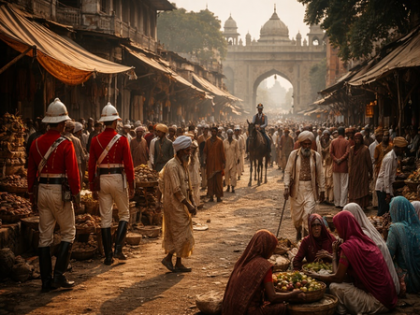
Curtain of darkness: How British empire denied 'light of knowledge' to further its despotism (From the Archives)
New Delhi, Dec 28 The British occupation of India was built upon a great lie: the assertion that foreign dominion served the "welfare and happiness of the inhabitants". The East India Company (EIC), a vast trading corporation that had morphed into a territorial sovereign, continually boasted of establishing "courts of justice" and creating "new and valuable property" for the natives, claiming to have replaced a chaotic, precarious past.
Yet, this veneer of benevolence barely concealed a system weighed down by colossal debt, maintained through military force and psychological manipulation, and structured to systematically drain the resources of the conquered land.
The question of missionary access was not about faith; it was about power, control, and the inherent fragility of a government that survived because its 60 million subjects remained unaware of the "peculiar tenure" by which they were ruled by a mere one million Britons.
The Suppressed Voice: A Conspiracy of Silence
Before addressing the explicit petition for Christian propagation, one must grasp the absolute control the EIC exercised over all forms of intellectual and political discourse within India. The British understood that stability rested on "moral influence, and in a great degree even by prejudice". To maintain this delicate balance, they implemented a rigorous system of censorship that rendered the press in India "perfectly fettered".
The regulations required that newspapers receive the "sanction of the secretary of the government" before publication, under the penalty of "immediate embarkation for Europe". The rationale for this draconian measure was openly discussed in Parliament: the administration feared publications that could criticize native religion and customs, thereby stirring up "irritation and hostility". Crucially, they feared that uncensored information would expose the truth to the people, informing natives "of the peculiar tenure by which the British government held their power".
Critics of the policy, such as Sir Thomas Turton, articulated the brutal clarity of this despotism: "Nothing could be more dangerous than freedom of discussion under a government founded upon blood and supported by injustice". He noted the absurdity of speaking of press liberty in India, where the government was "not inferior to that of... Tunis or Algiers". Another critic, Mr. Whitbread, observed that the ultimate objective was to keep the people of India "in darkness as to the nature of their government".
This climate of intellectual suppression—a government that had usurped authority and power through "conquest, by compact, and by forfeiture" (and possibly "fraud")—created the perfect environment to impede any unwelcome ideas, including Christianity, if those ideas threatened the political status quo. The denial of the “light of the Gospel”, as one observer noted, was a move to "support a political despotism".
The Petition of Scorn: Deplorable Ignorance
It was against this backdrop of political fear and intellectual control that the Society in Scotland for Propagating Christian Knowledge (SSPCK) submitted its powerful petition to the House of Commons on February 19, 1813.
The petition was twofold in its appeal: it sought parliamentary provision in the Charter renewal to allow the Society to impart the benefits of Christianity to the natives of India and simultaneously to afford religious worship and instruction to Scottish members of the Church of Scotland residing in that part of the British empire.
The urgency of their mission was justified by a severe moral indictment of the Indian populace. The SSPCK noted that the native inhabitants "have long been and still continue in a state of deplorable ignorance". They further claimed that the people were "addicted to various idolatrous and superstitious usages of the most degrading and horrible description".
This characterization—in reality—was not humanitarian concern but profound colonial arrogance. It was an imperial judgment passed upon a civilization that had established complex political systems, profound philosophical traditions, and thriving industries long before the EIC arrived. The accusation of "deplorable ignorance" was particularly galling coming from a nation whose own control over India rested on keeping the native population ignorant of their political status.
The petitioners also highlighted the impediments faced by Scottish members themselves. Although official policy claimed "perfect toleration" prevailed in India, the EIC’s licensing system ensured that members of the Church of Scotland, who were employed in civil and military departments, were "precluded from enjoying the ordinances of Christianity agreeably to the forms of the Church to which they are attached". This exclusion occurred because the EIC was "not in the habit of granting" licenses to clergy outside of the established Anglican Church, demonstrating that even British subjects were denied religious freedom if they belonged to a non-Anglican denomination.
The Irony of Moral Superiority
The Scottish Society's zeal to correct India's "idolatrous and superstitious usages" stood in sharp contrast to the actual moral landscape created by the British administration itself. The records reveal that the EIC governance had produced an "increase of crime, enormous" and widespread depravity.
1. Justice Denied: Despite the Company’s claims of established justice, the judicial system was effectively inaccessible for many. Civil justice was "virtually denied to suitors" due to exorbitant fees and stamped paper requirements, sometimes amounting to 50 down to 7 and 6 per cent. on the amounts claimed. The overall cost of administering justice was even claimed to be higher in British India than in the whole of Europe.
2. Economic Devastation: The system imposed by the British was a "systematically engineered process of colonial underdevelopment". Exploitative land revenue policies led to "agrarian stagnation, the growth of absentee landlordism, and peasant misery". Peasants were forced into debt traps and coerced by high, arbitrarily fixed tax rates even when crops failed. This deliberate economic destruction was the true "deplorable ignorance" concerning how to govern justly.
3. Moral Hypocrisy of War: The British policy itself tolerated acts of barbarity that contradicted any claim to moral superiority. The execution of the Killedar of Talnier fort after his surrender, an act deemed questionable by European standards of justice even in war, demonstrated that the British military apparatus could disregard "principles of justice and humanity" when convenient.
In this context, the argument that India needed saving from its own religious practices rings hollow. The British government, while censoring religious tracts that criticized native religion to avoid "tumultuous proceedings", was simultaneously funding its territorial acquisitions by incurring massive debts, totaling around £26 million by 1813, absorbed largely by military activities. The perceived need to protect "native customs" was merely a tool to safeguard the fragile financial and military basis of their domination.
The Trade-Off: Commerce Over Conversion
The core issue preventing unrestrained missionary activity was the EIC’s commercial monopoly itself, which was up for renewal in 1814. The EIC feared that extensive European interaction, particularly under the guise of religious instruction, would destabilize the lucrative trade, especially the vital commerce with China.
The policy of restricting religious influence was directly analogous to the EIC's attempts to stifle India's economic potential. The use of Indian-built ships, which utilized India’s "great natural advantages" like durable teak wood, was resisted primarily to protect the British shipbuilding industry and British seamen. Preventing the use of Indian ships and sailors was an act of "injustice and oppression" that denied India the reward of its industry.
The EIC argued that unrestricted importation from India would endanger "any pledge on their part for the good government of India". This meant the continuation of the colonial system -- military control, revenue extraction, and commercial privilege -- was paramount. The government wisely thought that it should abstain from openly exerting itself to further Christianity, lest they should be represented to the people as "attempting to impose upon them a new religion".
The resistance was thus purely pragmatic. The introduction of Christianity was seen as a potential trigger that could "unhinge the whole frame of Indian society" -- a framework painstakingly erected upon military dominance and economic servitude.
Conclusion: The Despot's Dilemma
The debate over the impediments to Christian missionary activity in 1813 reveals a government caught in a terrible dilemma of its own making. Having gained political and territorial control through means critics described as resting on "blood and... injustice", the East India Company could only maintain its rule by stifling two things: the freedom of political expression (through the "perfectly fettered" press) and the freedom of religious propagation.
The irony is acute: The EIC justified its presence by claiming to alleviate the "deplorable ignorance" of the native population. Yet, Parliament was told that giving the people access to even simple legal proceedings was dangerous, and that spreading Christian light was risky, because it might lead to "tumultuous proceedings".
Ultimately, the source of the "impediment" was not the hostility of the native population, but the inherent instability of the colonial administration. By restricting the clergy and suppressing Christian outreach, the British were attempting to prevent any intellectual or moral force from exposing the raw nerve of their dominion. They chose political survival over said spiritual outreach, military security over so called moral consistency. The door to “spiritual and intellectual freedom” remained closed, guarded not by religious conviction, but by the overwhelming, practical fear of imperial collapse.
(The Author is a researcher specialising in Indian history and contemporary geo-political affairs)
Disclaimer: This post has been auto-published from an agency feed without any modifications to the text and has not been reviewed by an editor
Open in app