
Earthquake of magnitude 3.8 strikes Afghanistan
By ANI | Updated: January 14, 2026 14:35 IST2026-01-14T20:02:18+5:302026-01-14T14:35:04+5:30


Kabul [Afghanistan], January 14 : An earthquake of magnitude 3.8 struck Afghanistan on Wednesday, a statement by the National ...
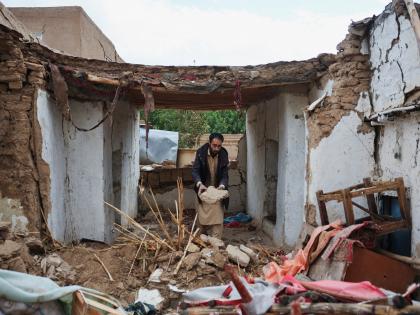
Earthquake of magnitude 3.8 strikes Afghanistan
Kabul [Afghanistan], January 14 : An earthquake of magnitude 3.8 struck Afghanistan on Wednesday, a statement by the National Center for Seismology (NCS) said.
The earthquake occurred at a depth of 90km.
In a post on X, the NCS said, "EQ of M: 3.8, On: 14/01/2026 13:19:43 IST, Lat: 36.47 N, Long: 71.16 E, Depth: 90 Km, Location: Afghanistan."
{{{{twitter_post_id####EQ of M: 3.8, On: 14/01/2026 13:19:43 IST, Lat: 36.47 N, Long: 71.16 E, Depth: 90 Km, Location: Afghanistan.
For more information Download the BhooKamp App https://t.co/5gCOtjdtw0 @DrJitendraSingh @OfficeOfDrJS @Ravi_MoES @Dr_Mishra1966 @ndmaindia pic.twitter.com/8vx79ReT8p
— National Center for Seismology (@NCS_Earthquake) January 14, 2026
Earlier on Tuesday, another earthquake of magnitude 4.1 struck the region at a shallow depth of 10km, making it susceptible to aftershocks.
In a post on X, the NCS said, "EQ of M: 4.1, On: 13/01/2026 20:19:01 IST, Lat: 34.74 N, Long: 68.52 E, Depth: 10 Km, Location: Afghanistan."
EQ of M: 4.1, On: 13/01/2026 20:19:01 IST, Lat: 34.74 N, Long: 68.52 E, Depth: 10 Km, Location: Afghanistan.
For more information Download the BhooKamp App https://t.co/5gCOtjdtw0 @DrJitendraSingh @OfficeOfDrJS @Ravi_MoES @Dr_Mishra1966 @ndmaindia pic.twitter.com/QLsXlhH9ym
— National Center for Seismology (@NCS_Earthquake) January 13, 2026
Another earthquake of magnitude 4.0 struck the region on the same day at a depth of 10km.
In a post on X, the NCS said, "EQ of M: 4.0, On: 13/01/2026 17:21:19 IST, Lat: 37.34 N, Long: 74.58 E, Depth: 10 Km, Location: Afghanistan."
}}}}EQ of M: 4.0, On: 13/01/2026 17:21:19 IST, Lat: 37.34 N, Long: 74.58 E, Depth: 10 Km, Location: Afghanistan.
For more information Download the BhooKamp App https://t.co/5gCOtjdtw0 @DrJitendraSingh @OfficeOfDrJS @Ravi_MoES @Dr_Mishra1966 @ndmaindia pic.twitter.com/wtw5RYHXQ3
— National Center for Seismology (@NCS_Earthquake) January 13, 2026
Shallow earthquakes are generally more dangerous than deep earthquakes. This is because the seismic waves from shallow earthquakes travel shorter distances to the surface, resulting in stronger ground shaking, greater structural damage, and potentially higher casualties.
Afghanistan frequently experiences earthquakes, particularly in the Hindu Kush region, which lies in a highly active seismic zone, according to the Red Cross.
Afghanistan's vulnerability to earthquakes is linked to its location along the collision zone between the Indian and Eurasian tectonic plates. A major fault line also passes through parts of the country, including the Herat region.
The United Nations Office for the Coordination of Humanitarian Affairs (UNOCHA) notes that Afghanistan remains extremely vulnerable to natural disasters, including earthquakes, landslides and seasonal flooding. Repeated tremors worsen the situation for communities already struggling with decades of conflict and limited development, leaving them with minimal resilience to withstand multiple shocks.
Disclaimer: This post has been auto-published from an agency feed without any modifications to the text and has not been reviewed by an editor
Open in app