
Gagan Thapa elected new president of Nepali Congress in split party convention
By IANS | Updated: January 15, 2026 11:35 IST2026-01-15T11:32:31+5:302026-01-15T11:35:15+5:30


Kathmandu, Jan 15 A controversially held Special General Convention (SGC) of the Nepali Congress elected Gagan Thapa as ...
Gagan Thapa elected new president of Nepali Congress in split party convention
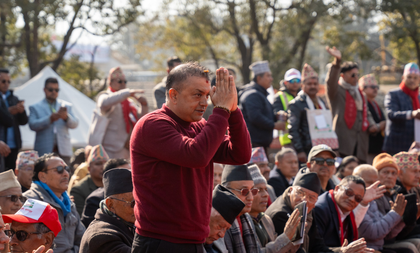
Kathmandu, Jan 15 A controversially held Special General Convention (SGC) of the Nepali Congress elected Gagan Thapa as the new president of the grand old party, hours after he was expelled from the party by a faction led by former Prime Minister Sher Bahadur Deuba.
At midnight on Wednesday, the SGC also elected other members of the Central Working Committee. Bishwa Prakash Sharma and Pushpa Bhusal were elected vice-presidents, while Pradeep Poudel and Gururaj Ghimire were elected general secretaries.
The development marks a decisive break from the old generation to a new one, but at the cost of a split within the party.
The first major challenge for the new leadership is securing recognition from the Election Commission -- or potentially the Supreme Court -- as the legitimate leadership of the Nepali Congress. The Election Commission has confirmed that both factions have submitted letters claiming legitimacy.
This is the second time in 23 years that the party has suffered a split, once again raising questions about its electoral prospects ahead of the scheduled election on March 5.
After being elected president, Thapa promised to work in a way that would make all Nepali Congress leaders and cadres feel proud to be members of the party.
In his speech at the SGC, he said the Nepali Congress would stand as a reassuring force that cares for the general public, while accusing the old leadership of ignoring the voices of people on the streets.
Several rounds of talks between the SGC organisers and the Deuba-led faction failed over the issue of whether Deuba should relinquish power before the elections. Following the breakdown of negotiations, the SGC organisers proceeded with the leadership election, while the Deuba faction announced disciplinary action against three leaders, including Thapa and Sharma, then general secretaries, and Farmullaha Mansur, then joint general secretary.
As the Deuba faction refused to convene the SGC despite repeated pleas from a majority of elected members for a general convention, Thapa and Sharma called the SGC without Deuba’s approval.
In 2002, Deuba, who was prime minister at the time, formed his own party -- Nepali Congress (Democratic) -- after being expelled by the party led by the late Girija Prasad Koirala over his recommendation to dissolve the House of Representatives, a move that went against the party’s decision.
Following the success of the 2006 people’s movement, the two parties merged to form a single Nepali Congress.
Thapa, 49, rose to prominence as a student leader during the 2006 people’s movement, when his speeches denouncing the monarchy and advocating the establishment of a republic resonated strongly with young people.
As a leader of the party’s student wing, the Nepal Student Union, he delivered fiery speeches against the monarchical system at a time when the country was under repressive royal rule.
During that period, the Nepali Congress leadership itself was largely silent on transforming the country into a republic, instead adhering to the “two-pillar theory” of constitutional monarchy and multiparty democracy.
Since emerging into the national spotlight two decades ago, Thapa has remained a widely popular figure within the party and, to a large extent, among the general public.
Following the success of the 2006 people’s movement, the party included him on its proportional representation list for the 2008 Constituent Assembly election, through which he entered the Assembly.
After the first Constituent Assembly failed to deliver a new constitution, fresh elections were held in 2013. Thapa contested from the Kathmandu–4 constituency and won. He went on to win the same seat in the 2017 and 2022 elections, cementing his position as a key figure in national politics.
Within the party, Thapa was defeated when he first contested the post of general secretary at the 13th general convention in 2016. However, he ran again for the same position at the 14th convention in 2021 and won.
Following the 2022 general election, Thapa challenged Deuba for the leadership of the parliamentary party but was defeated. Deuba again faced pressure from Thapa after the Gen Z movement in September last year, when Thapa teamed up with fellow general secretary Bishwa Prakash Sharma to call for an SGC, arguing that the party needed change before the elections scheduled for March this year.
With the party leadership refusing to heed calls for the SGC, Thapa and Sharma convened it themselves. The convention ultimately elected Thapa as the new president -- at the cost of a split in the party.
Disclaimer: This post has been auto-published from an agency feed without any modifications to the text and has not been reviewed by an editor
Open in app