
IANS Year Ender 2025: Bangladesh stares at possible economic slide as violence shows no sign of abatement
By IANS | Updated: December 28, 2025 22:45 IST2025-12-28T22:43:53+5:302025-12-28T22:45:16+5:30



New Delhi, Dec 25 It was a year of uncertainty for Bangladesh, marked with violence, arson, religious bigotry, ...
IANS Year Ender 2025: Bangladesh stares at possible economic slide as violence shows no sign of abatement
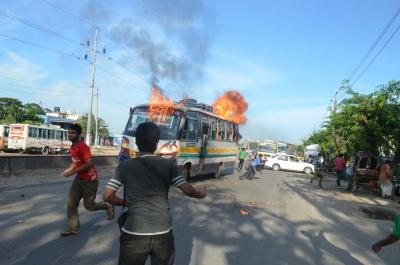
New Delhi, Dec 25 It was a year of uncertainty for Bangladesh, marked with violence, arson, religious bigotry, and killings as the transitional caretaker administration led by a Nobel laureate watched helplessly.
Even as the return of a Zia family scion brought hopes -- at least for a section -- in the beleaguered country, an explosion the day before reminded Dhaka of the bitter truth. Since the August 2024 uprising, Bangladesh has slid from a hopeful democratic and economic reset into a volatile transition marked by weak state control, rising political violence, and a geopolitical realignment that risks destabilising the region.
The Muhammad Yunus-led interim administration’s inability to restore order has deepened domestic ruptures and invited external influence, posing a grave threat to regional security. The country’s leading newspaper, Prothom Alo, had quoted the Bangladesh Hindu Bouddha Christian Oikya Parishad (Bangladesh Buddhist Christian Unity Council) claiming 2,442 incidents of violence against religious and ethnic minorities across the country between the student uprising on August 4, 2024, and June 30 this year, a span of 330 days.
In recent times, hostility against New Delhi has been marked by threats to isolate India's Northeastern states and provide refuge to separatists by leaders like Hasnat Abdullah of the National Citizen Party. In December, violence erupted across Bangladesh following the death of youth leader Sharif Osman Hadi. He was among the top leaders in the 2024 uprising that led to the fall of Sheikh Hasina’s regime. Arson, attacks on media houses, and anti-India demonstrations re-erupted, leading the country into more chaos.
Meanwhile, external actors have offered incentives to cultivate influence in Dhaka while the state is distracted, further complicating governance. Dhaka’s foreign policy shifted, with the interim administration reaching out to Pakistan, the same country it fought to attain independence in 1971, and China.
A recent report from India’s Parliamentary Committee on External Affairs on “Future of India-Bangladesh Relationship” observed with concern the “increasing presence” of China in Bangladesh, “especially through infrastructure, military cooperation, and port developments”.
Among the experts who shared their views with the committee, one “highlighted five drivers of the current challenge: generational discontinuity, collapse of the 1971 consensus, rise of new political forces, rise of Islamic radicalism and strategic realignment with China and Pakistan”.
The Committee also noted Bangladesh’s Jamaat-e-Islami leaders' visit to China, “which clearly indicates its broad engagement with various factions in Bangladesh, further solidifying its presence”. It further added, “concerned to know that a submarine base has been built by China at Pekua, capable of accommodating eight submarines when Bangladesh has only two”.
Meanwhile, security forces in Bangladesh appear overstretched and overwhelmed, limiting coherent responses to coordinated violence. Also, the interim government faces legitimacy challenges with competing narratives about the uprising and prosecutions of former officials. It has polarised the society and hampered consensus on reforms.
Amidst threats to its stability looms the uncertainty of Bangladesh attaining the status of a developing nation in 2026. The United Nations General Assembly had adopted a resolution in 2021 to elevate Bangladesh, along with Nepal and the Lao People’s Democratic Republic, from their status as least developed countries (LDC).
It is significant for the nation, where this transition presents several opportunities, but the ongoing volatility poses serious challenges for Dhaka’s path to economic growth and trade relations. “After remaining a role model for poverty reduction for over three decades, Bangladesh of late is beginning to show signs of sliding down on the scale of metrics used domestically and internationally,” reported the Dhaka-based Financial Express newspaper, quoting a survey by Bangladesh Institute of Development Studies (BIDS).
Additionally, a World Bank report said, “In 2025, the economic situation is expected to mirror the slow conditions of 2020, the pandemic year, leading to a rise in extreme poverty to 9.3 per cent and pushing an additional 3 million people into poverty.”
The report points to a lack of job opportunities for young graduates and women in urban areas. Yet, economists observed the proposed national budget for the 2025-26 financial year, which lacked the structural depth needed to address Bangladesh’s long-standing economic challenges, reported New Age, another Dhaka-based newspaper.
“While the budget attempts to reflect sincerity and pragmatism, they say, it ultimately falls short of offering the reforms required to ensure sustainable development,” the report had pointed out.
Disclaimer: This post has been auto-published from an agency feed without any modifications to the text and has not been reviewed by an editor
Open in app