
Macron mediates as Pezeshkian signals readiness for US talks amid naval standoff in Hormuz
By ANI | Updated: April 14, 2026 17:25 IST2026-04-14T22:54:29+5:302026-04-14T17:25:17+5:30



Tehran [Iran], April 14 : French President Emmanuel Macron has intensified his role as a diplomatic mediator, holding separate ...
Macron mediates as Pezeshkian signals readiness for US talks amid naval standoff in Hormuz
Tehran [Iran], April 14 : French President Emmanuel Macron has intensified his role as a diplomatic mediator, holding separate discussions with US President Donald Trump and Iranian President Masoud Pezeshkian to salvage stalled peace negotiations.
The diplomatic push comes as the Strait of Hormuz remains a dangerous flashpoint, with a US naval blockade currently in effect.
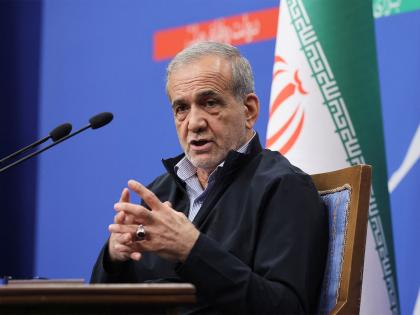
According to Arab News, President Pezeshkian on Tuesday expressed Tehran's willingness to return to the table, provided the discussions adhere to international law.
Iran has set clear conditions for a full ceasefire, emphasising that any deal must include the cessation of hostilities in Lebanon.
Pezeshkian noted that Europe, and France in particular, can play a "constructive role" in bridging the gap with Washington.
Despite the recent collapse of talks in Islamabad, Tehran maintains it is approaching the process with "determination and seriousness," though it insists the ultimate outcome rests on Washington's willingness to compromise.
French President Emmanuel Macron is pushing for a ceasefire and reopening of the Strait of Hormuz after meeting with Iranian President Massoud Pezeshkian and US President Donald Trump.
He emphasises the need for unconditional reopening of the strait without controls or tolls. France and the UK will host a conference on Friday to discuss a multilateral mission to restore freedom of navigation in the Strait.
Following his meetings with both leaders, President Macron called for an immediate resumption of the Islamabad dialogue to avoid "new phases of escalation."
"Yesterday, I met with Iranian President Massoud Pezeshkian, as well as with American President Donald Trump. I called for resuming the negotiations interrupted in Islamabad, for clarifying misunderstandings, and for avoiding new phases of escalation," Macron posted on X.
His proposal focuses on three critical pillars, expanding the current truce to include Lebanon to ensure regional stability, the immediate reopening of the Strait of Hormuz without "controls, tolls, or conditions." and France and the United Kingdom will host a video conference this Friday in Paris to establish a "purely defensive" mission aimed at restoring freedom of navigation.
"It is essential in particular that the ceasefire be strictly respected by all, and that it include Lebanon. It is equally important that the Strait of Hormuz be reopened unconditionally, without controls or tolls, as soon as possible. Under these conditions, negotiations should be able to resume quickly, with the support of the main stakeholders. France and the United Kingdom will also host this Friday, in Paris, a conference that will bring together by videoconference non-belligerent countries ready to contribute alongside us to a multilateral and purely defensive mission, aimed at restoring freedom of navigation in the strait when security conditions permit," he posted.
The situation on the ground remains tense. While the US Navy implements a blockade to curb Iranian oil exportsa tactic President Trump describes as a means to "work a deal"the international community is moving toward independent maritime security.
As non-belligerent countries prepare to join the French-led maritime mission, the focus shifts back to Islamabad, where a second round of direct US-Iran talks is reportedly being coordinated for the coming weekend.
Earlier, US President Donald Trump on Monday stated that his administration received a call "from the other side" regarding Iran, claiming that the leadership in Tehran is now eager to negotiate.
Speaking to reporters at the White House, the President remarked that "they'd like to make a deal very badly."
Trump's remarks to the reporters came merely hours after the US imposed a naval blockade on Iranian ports and after marathon talks in Pakistan this weekend failed to yield a deal.
The President maintained that the primary sticking point in the negotiations remains Tehran's nuclear ambitions, asserting that "Iran will not have a nuclear weapon."
As the security situation evolves in the region, Iran has meanwhile called for compensation from five Arab countries, accusing them of enabling "US-Israeli aggression" by allowing their territories to be used for attacks against the country, the Iranian state media, Press TV, reported.
In a letter addressed to UN Secretary-General Antonio Guterres and Security Council President Jamal Fares Alrowaiei, Iran's Ambassador and Permanent Representative Amir-Saeid Iravani rejected compensation demands made by Bahrain, Saudi Arabia, Qatar, the United Arab Emirates (UAE), and Jordan.
In a letter sent on Monday, Iravani denounced Washington's move as an "illegal act of aggression" that threatens regional and international peace and security.
"The imposition of a naval blockade is a gross violation of the sovereignty and territorial integrity of the Islamic Republic of Iran," Iravani wrote, adding that the measure was publicly announced by US Central Command (CENTCOM) on April 12.
He said the US action violates Article 2, paragraph 4 of the UN Charter, which prohibits the threat or use of force, and constitutes "a textbook example of aggression under international law."
Disclaimer: This post has been auto-published from an agency feed without any modifications to the text and has not been reviewed by an editor
Open in app