
"Not ideal for one country to have total control over global shipping," says former Pentagon advisor
By ANI | Updated: April 9, 2026 15:00 IST2026-04-09T20:25:40+5:302026-04-09T15:00:36+5:30



London [UK], April 9 : Jasmine El-Gamal, former Pentagon Middle East advisor and CEO of Averos Strategies, said on ...
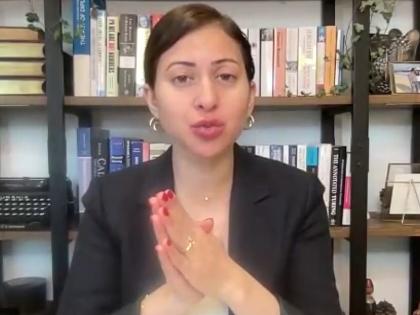
"Not ideal for one country to have total control over global shipping," says former Pentagon advisor
London [UK], April 9 : Jasmine El-Gamal, former Pentagon Middle East advisor and CEO of Averos Strategies, said on Thursday that there will be multiple parties at the table trying to come up with a workable solution that evokes collective security of the Strait of Hormuz.
Gamal, in a conversation with ANI, was asked about the future of the Strait of Hormuz, to which she said that it is not ideal for any one country to have total control over global shipping.
"Well, that obviously is going to be unacceptable for the US and also not an ideal situation for any country. For any one country to have total control over global shipping and, as a result, global markets is not a workable solution. So you are going to see multiple parties at the table trying to come up with a workable solution that evokes collective security of the strait," she said.
Gamal said that Oman has already been in talks with Iran to start talking about potential solutions for this.
"How that happens remains to be seen. Oman has already been in talks with Iran to start talking about potential solutions for this, where Iran feels it's okay with it, but also other countries feel as well. Iran, also, through the Houthis, Ansar Allah in Yemen, has effective potential control over Bab al-Mandeb, which goes into the Red Sea, which is an alternative shipping route. And then, of course, you have the Suez Canal and the Cape of Good Hope down south," she said.
Gamal said that negotiations will be over what a kind of global collective responsibility around the Strait of Hormuz looks like.
"So there are multiple shipping routes, but of course, the main one, one of the main ones, if not the main one, that's being used is the Strait of Hormuz. So that's why I think you will start to see negotiations over what a kind of global collective responsibility around that strait looks like. They're not going to be easy conversations because Iran feels like it has proven that it can control the Strait, and nobody can really do anything about it without imposing a very high cost on them. But we'll see how the negotiations go," she said.
Gamal was then asked who she thinks won the war.
"On one hand, it's a simple question, but on the other hand, it's not. It depends on how you define victory. It depends on every country's objectives going into this war. You know, the US started this war in the middle of negotiations with Iran. And so the bar is much higher for them to be able to declare victory. You know, the US, before this war started, the Strait of Hormuz was open. And now it's negotiating to open the Strait of Hormuz," she said.
"So it actually worked backwards in a sense and is now trying to get back to where it was in the beginning. So it's very hard to call that a victory. It's difficult," she said.
Gamal said that the war has weakened Iran's ballistic missile program and its economy.
"On the other hand, from a purely military perspective, it has weakened Iran's ballistic missile program. It has weakened Iran economically, but not to the point where it has destroyed the regime's infrastructure. Yes, it killed Ayatollah Khamenei. He was very old anyway. He was probably not going to be around for much longer. His son is now in power. His son may be incapacitated based on certain reports. But even if his son is also killed, there will be another person to take his place," she said.
Gamal said that the Iranian regime, as a structure, has not been eliminated, although it has been weakened.
"The regime as a structure has not been eliminated, although it has been weakened. Proxies are still weakened as we talked about earlier, but not completely defeated. Again, Ansar Allah or the Houthis in Yemen remain very active and capable of inflicting great cost. They chose not to get too involved so far in the war. They came in towards the very end, but that doesn't mean that they don't have the capacity to do so. And of course, Hezbollah in Lebanon is not completely defeated either," she said.
Gamal said that it would be tough for US President Donald Trump to declare victory over Iran, because it emerged as a survivor.
"So it is going to be difficult for President Trump to declare victory over this, because Iran was the one attacked and came out of it as a survivorand not only a survivor, as someone who was able to extract costs from this and impose costsit will be easier for them objectively to declare victory," she said.
Gamal said that they are at the beginning of a very difficult period of negotiations.
"But again, I keep coming back to the fact that we are just at the beginning of this next phase. We could be right back here where we started in two weeks. So I would just temper expectations about talking about any final verdicts. I think we're at the beginning of a very difficult period of negotiations. We don't know if the ceasefire will hold in the next two years. And so I want to be just very cautious about the phase that we're entering into," she said.
Meanwhile, Trump on Wednesday (local time) said that the US military deployments will remain in place around Iran until the "real agreement" reached is fully complied with.
Disclaimer: This post has been auto-published from an agency feed without any modifications to the text and has not been reviewed by an editor
Open in app