
Pakistan tops Global Terrorism Index amid drop in terrorism deaths worldwide: Report
By IANS | Updated: April 11, 2026 20:50 IST2026-04-11T20:48:12+5:302026-04-11T20:50:21+5:30



Washington, April 11 While global terrorism deaths dropped by 28 per cent and attacks by nearly 22 per ...
Pakistan tops Global Terrorism Index amid drop in terrorism deaths worldwide: Report
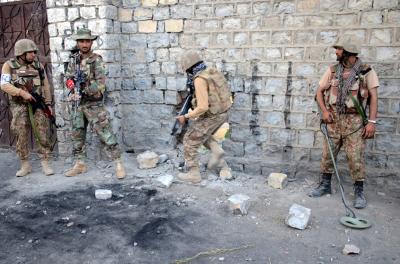
Washington, April 11 While global terrorism deaths dropped by 28 per cent and attacks by nearly 22 per cent, Pakistan has emerged as an outlier, topping the Global Terrorism Index 2026 with 1,139 terrorism-related deaths last year, a report highlighted on Saturday.
Writing for online magazine ‘American Thinker', Fatima El Hashimi, a Moroccan researcher and journalist, said that violence has become routine in Pakistan - a grim normalisation reflecting a deeper and more dangerous reality of the country's rapidly deteriorating security situation, marking the sixth consecutive year of increasing terrorism.
She stressed that this spike underscores the continuation of a sustained and troubling trend.
“Terrorism-related deaths in Pakistan have risen every year for six years, and the latest increase is the largest year-on-year jump in a decade. The number of attacks more than doubled from 517 in 2023 to 1,099 in 2024, then showed a slight decline in 2025, though it remained at historically elevated levels,” Fatima mentioned.
She noted that the report's indicators, including the incidents, fatalities, injuries, and hostages, depict a picture of a country where militant violence is not only “persistent but evolving in ways that challenge the state’s capacity to respond. ”
The expert stated that Khyber Pakhtunkhwa and Balochistan continue to be the epicentres of violence, accounting for over 74 per cent of attacks and 67 per cent of deaths in 2025.
“These regions, long neglected in terms of governance and development, continue to bear the brunt of Pakistan’s internal conflict,” Fatima added.
Pakistan’s counterterrorism strategy, she said, remains “heavily skewed toward kinetic action raids, reprisals, and targetted strikes”, while the “non-kinetic pillars of counter-extremism remain weak, fragmented, or entirely absent.”
“One of the clearest symptoms of this weakness is the absence of a credible, verifiable terrorism database. Global organisations rely on transparent, evidence-based reporting, yet Pakistan’s law enforcement agencies often expect the world to accept their claims without documentation.” Fatima stated.
She argued that lasting peace will remain elusive unless Pakistan moves beyond a force-driven strategy to address deeper issues, including ideological militancy, cross-border sanctuaries, political instability, and governance deficits.
“Breaking this cycle requires more than firepower. It demands political clarity, consistent civilian governance in conflict-hit regions, and serious regional diplomacy, particularly with Afghanistan. It requires police reforms that strengthen local law enforcement rather than sidelining it. It requires intelligence sharing across agencies that often operate in silos. And it requires judicial reforms that ensure militants are prosecuted effectively rather than recycled back into the conflict,” Fatima further emphasised.
Disclaimer: This post has been auto-published from an agency feed without any modifications to the text and has not been reviewed by an editor
Open in app