
Press freedom under siege in Balochistan as journalists face mounting threats: Report
By ANI | Updated: December 31, 2025 12:10 IST2025-12-31T12:09:24+5:302025-12-31T12:10:05+5:30


Balochistan [Pakistan], December 31 : A new report by media watchdog Freedom Network has raised serious concerns over the ...
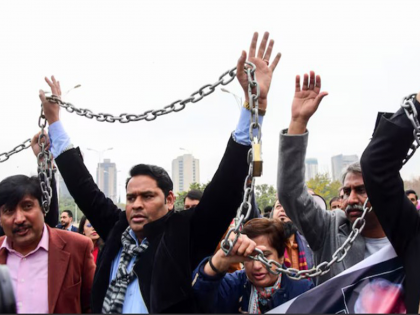
Press freedom under siege in Balochistan as journalists face mounting threats: Report
Balochistan [Pakistan], December 31 : A new report by media watchdog Freedom Network has raised serious concerns over the worsening state of journalism in Balochistan, warning that growing intimidation, censorship and structural neglect have pushed the province's media landscape into a deep crisis.
The findings reveal how journalists are increasingly forced into silence amid pressure from multiple power centres, as reported by The Balochistan Post.
According to The Balochistan Post, in its report titled "State of Media Freedoms, Access to Information and Safety of Journalists and Media Professionals in Balochistan - The Way Forward," the study outlines how fear and repression have replaced independent reporting across the province.
Speaking at the report's launch, Freedom Network Executive Director Iqbal Khattak said journalism in Balochistan has reached a "dangerously constrained" phase, where survival often depends on self-censorship rather than professional integrity.
The report identifies a combination of security threats, political interference, weak governance and economic fragility as key factors undermining media freedom.
It notes that local journalists face constant pressure from both state and non-state actors, resulting in minimal coverage of public-interest issues. As a result, citizens are increasingly deprived of accurate and timely information, further isolating the province from national discourse.
The report also highlights the collapse of regional media infrastructure. While Pakistan witnessed a boom in electronic media after the early 2000s, Balochistan remained largely excluded.
National television channels have gradually shut down or downsized their Quetta bureaus, and no independent terrestrial current-affairs channel operates in the province. Print media, largely confined to urban centres, continues to struggle with high production costs, weak circulation and limited readership, as highlighted by The Balochistan Post.
Digital access remains another major challenge. Only a small fraction of Balochistan's population has reliable internet access, and repeated shutdowns in areas such as Panjgur and Khuzdar have further restricted the flow of information.
These disruptions, the report notes, severely hamper journalists' ability to report, verify facts and ensure personal safety.
The study also sheds light on the severe gender imbalance in the media sector. Women journalists face harassment, mobility restrictions and workplace discrimination, often being denied field assignments or having their work broadcast under male colleagues' names, as reported by The Balochistan Post.
Disclaimer: This post has been auto-published from an agency feed without any modifications to the text and has not been reviewed by an editor
Open in app