
Serious doubts over UNHRC member Pakistan's commitment in preventing human rights violations at home
By IANS | Updated: December 12, 2025 21:20 IST2025-12-12T21:17:35+5:302025-12-12T21:20:17+5:30


Islamabad, Dec 12 Despite Pakistan's constitution containing provisions that guarantee fundamental rights to all citizens, the minorities in ...
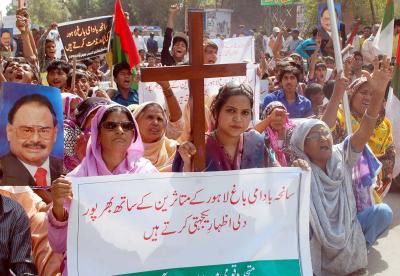
Serious doubts over UNHRC member Pakistan's commitment in preventing human rights violations at home
Islamabad, Dec 12 Despite Pakistan's constitution containing provisions that guarantee fundamental rights to all citizens, the minorities in the country continue to battle several challenges, including discriminatory laws, economic barriers, under-representation, sectarian attacks, and bias in textbooks promoting religious intolerance.
While Pakistan is part of the United Nations system and is actively engaging in the UN human rights bodies, having recently been elected to the UN Human Rights Council (UNHRC) for the term 2026-2028 - its sixth term on the Council since 2006 - serious doubts remain about the country's commitment in promoting human rights at home.
"Human rights violations against minorities in Pakistan include systemic discrimination, forced conversions, misuse of blasphemy laws, torture/extrajudicial killings, and marginalization, which affect religious minorities such as Hindus, Sikhs, and Christians," Emanuel Adil Ghouri wrote in Pakistan Christian Post.
Citing the data compiled by the National Human Rights Commission of Pakistan till July 2024, the report details that 767 people were in prisons across Pakistan on blasphemy charges compared to 213 suspects imprisoned on blasphemy charges in 2023, 621 in 2020, and 99 in 2020.
According to the same study, at least 104 people were extrajudicially killed after blasphemy charges between 1994 and 2024, of whom 26 per cent were Christians, one Hindu and one Buddhist, while the religion of two people was unknown.
The Centre for Social Justice (CSJ), a research organisation on forced religious conversion of minority girls in Pakistan, mentioned that over 46 per cent of the victims were girls and women from the Hindu community while 44 per cent were Christians. Over 46 per cent of the victims were minors and around 33 per cent of the victims were aged between 11-15 years.
Furthermore, the report highlighted that minorities face issues like religious discrimination, religious freedom, political and social inequality. International human rights organisations, including the European Union and the United Nations, have repeatedly expressed their concern over the situation.
"According to the UN Declaration, various institutions and international human rights organizations consistently report that these safeguards are often not effectively implemented in practice, with significant challenges and human rights violations continuing. UN experts and the Secretary-General have repeatedly condemned attacks on religious and ethnic minorities in Pakistan and called for immediate action against the perpetrators. UN Special Rapporteurs have called for an end to widespread violence and discrimination," the Pakistan Christian Post report mentioned.
On December 9, a leading minority rights group drew attention to the killing of a Christian spiritual leader in Pakistan, who was shot dead outside his residence in Punjab province, barely two months after narrowly surviving a similar attempt on his life in Islamabad.
The Voice of Pakistan Minority (VOPM) mentioned that the attack took place on the morning of December 5, when Pastor Kamran, along with his daughter Numeer, was leaving home to drop her off at college. As they approached their car, the right body said, an assailant on a motorcycle ambushed them, opening fire at close range and hitting Kamran multiple times. He was rushed to the Civil Hospital in Gujranwala city in Punjab, where he later succumbed to his injuries.
The rights body highlighted that Kamran’s death sent shockwaves through the Christian community across Pakistan, leaving his wife, Salmina, and their three young children to grapple with the unimaginable loss.
According to the VOPM, the tragedy is made even more painful by the fact that Kamran had already faced violence for his dedication to serving others. Just two months ago, he was attacked by extremists in Islamabad, but he survived the shooting, though he was left injured.
“The brutal murder has reignited fears among Christians in Pakistan, already living with the constant threat of violence. Pastor Kamran’s death is not an isolated incident but part of a growing pattern of attacks against those who dare to stand for their faith in an increasingly hostile environment. The pain and loss felt by his family are echoed in the hearts of many who knew him and in the communities he served,” the VOPM stated.
The rights body stated that although police have begun an investigation, the reluctance of local authorities to take meaningful action raises concerns about the pursuit of justice.
“Pastor Kamran’s killing is yet another reminder of the deep-seated vulnerability of religious minorities in Pakistan and the impunity that often surrounds these heinous acts,” it added.
Disclaimer: This post has been auto-published from an agency feed without any modifications to the text and has not been reviewed by an editor
Open in app