
Tropical Cyclone Narelle: Australian Skies Turned Blood-Red Due to Cyclonic Storm? Here's What Happened
By Lokmat Times Desk | Updated: March 30, 2026 15:06 IST2026-03-30T15:05:21+5:302026-03-30T15:06:21+5:30



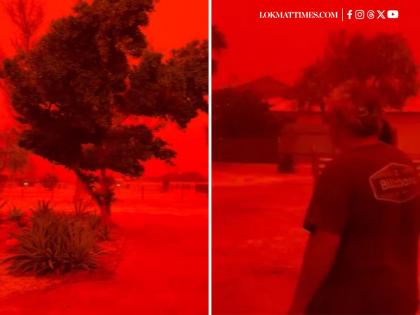
Parts of Western Australia witnessed an unusual natural phenomenon on March 27, 2026, when the sky turned a deep ...
Tropical Cyclone Narelle: Australian Skies Turned Blood-Red Due to Cyclonic Storm? Here's What Happened
Parts of Western Australia witnessed an unusual natural phenomenon on March 27, 2026, when the sky turned a deep red as Tropical Cyclone Narelle approached the coast. The rare event was reported in regions including Shark Bay and the Pilbara, with images and videos widely shared on social media.
The striking colour change was caused by dust carried by the cyclone from the arid Australian outback. Strong winds lifted iron-rich particles into the atmosphere, creating a red hue across the sky during daylight hours.
The Australian outback, which covers nearly 70% of the country’s landmass, includes vast, sparsely populated areas across Western Australia, the Northern Territory, South Australia and Queensland. The region’s soil contains high levels of iron oxide, also known as haematite, which reflects red light.
Also Read | Human Rights Watch calls Pakistan airstrike on Kabul medical facility 'Unlawful'.
Experts say the phenomenon is linked to the way light interacts with particles in the atmosphere. Under normal conditions, shorter wavelengths of light such as blue and violet are scattered more efficiently by small molecules like nitrogen and oxygen, giving the sky its usual blue colour.
However, during events such as cyclones, larger particles like dust and mineral aerosols are lifted into the air. These particles scatter light differently through a process known as Mie scattering, which can alter the colour of the sky. In this case, the presence of iron-rich dust resulted in the distinctive red appearance.
While such events are rare, they are not unprecedented in Australia, particularly in regions prone to dust storms and extreme weather. Authorities have not reported any major damage linked specifically to the red sky phenomenon, though Cyclone Narelle continues to be monitored for its broader impact.
Open in app