
Bill to repeal MGNREGA aligns with realities of transformed rural India, brings AI fraud check
By IANS | Updated: December 15, 2025 16:45 IST2025-12-15T16:41:31+5:302025-12-15T16:45:12+5:30


New Delhi, Dec 15 A guaranteed increase in employment days from 100 to 125 for rural households is ...
Bill to repeal MGNREGA aligns with realities of transformed rural India, brings AI fraud check
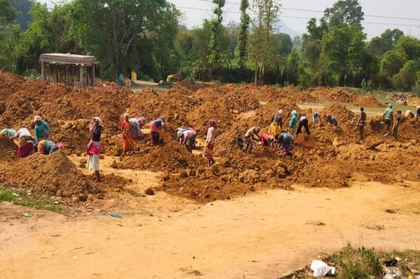
New Delhi, Dec 15 A guaranteed increase in employment days from 100 to 125 for rural households is among the highlights of a Bill proposed to repeal the 20-year-old MGNREGA that is struggling to address the realities of a transformed rural India, said an official on Monday.
The Viksit Bharat Guarantee for Rozgar and Ajeevika Mission (Gramin) (VB-G RAM G) Bill, 2025, proposed to be introduced in the Lok Sabha, is armed with AI-based fraud detection and has provisions for stronger social audits – twice a year for every Gram Panchayat – that promise to enhance transparency.
Apart from generating rural jobs, the proposed legislation may also benefit farmers directly through both labour availability and better agricultural infrastructure, said the Rural Development Ministry official.
The VB-G RAM G Bill aims to fix structural weaknesses, enhance employment and ensure coordination in the creation of assets for national development, according to a copy of the Bill which was listed in the supplementary list of businesses issued on Monday.
The Bill represents a major upgrade over MGNREGA, fixing structural weaknesses and establishing a modern statutory framework aligned with Viksit Bharat 2047, guaranteeing 125 days of wage employment per rural household whose adult members volunteer to do unskilled manual work, said an official.
The Bill aims to create both employment and durable rural infrastructure through four priority verticals: Water security through water-related works; core rural infrastructure; livelihood-related infrastructure, and Special works to mitigate extreme weather events.
While Aadhaar-seeded active workers under MNREGA have increased from 76 lakh in FY 13-14 to 12.11 crore in FY 2025-26, the existing rural job scheme suffers from structural problems as misappropriation continues, digital attendance is bypassed, and assets often fail to match expenditure, said the official.
“The scale and persistence of these issues showed that MNREGA’s architecture had reached its limits, making a new, modernised VB–G RAM G Bill necessary,” said the official.
To some extent, systemic failures in West Bengal and the related corruption necessitated a change in the rural job scheme.
Investigations in 19 districts of West Bengal found non-existent works, rule violations, and fund misuse, leading to a freeze, said a report.
Monitoring across 23 states in FY 2025–26 revealed works “not found or not commensurate with expenditure,” machine use where labour was required, and large-scale bypassing of the MGNREGA Mobile Monitoring System for attendance.
In 2024–25, misappropriation totalled Rs 193.67 crore across states. Only 7.61 per cent of households completed 100 days in the post-pandemic period.
Officials said these entrenched issues, such as leakages, weak verification, and poor compliance, required a new framework, not minor tweaks.
Also, MGNREGA was enacted in 2005, but rural India has transformed in the past two decades. Poverty fell sharply from 25.7 per cent (2011–12) to 4.86 per cent (2023–24), supported by rising consumption, incomes and financial access recorded in MPCE and NABARD RECSS surveys.
With stronger social protection, better connectivity, deeper digital access and more diverse rural livelihoods, the old framework no longer matches today’s rural economy, said an official.
--IANS
rch/dan
Disclaimer: This post has been auto-published from an agency feed without any modifications to the text and has not been reviewed by an editor
Open in app