
Concerns of Matua community may influence phase two of West Bengal Assembly polls
By IANS | Updated: April 27, 2026 15:35 IST2026-04-27T15:33:16+5:302026-04-27T15:35:13+5:30



New Delhi, April 27 When West Bengal goes to poll in the second and last phase of Assembly ...
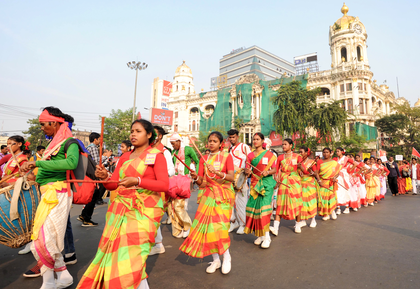
Concerns of Matua community may influence phase two of West Bengal Assembly polls
New Delhi, April 27 When West Bengal goes to poll in the second and last phase of Assembly election on Wednesday, the Matua community will hold an important position in determining the outcome of the May 4 results, especially in the two North Parganas districts, and Nadia.
Primarily spread across North 24 Parganas and Nadia, the bloc is seen as the single most decisive swing-constituency within several key Assembly seats.
From Gaighata and Bangaon Dakshin to Habra and Hasnabad, analysts estimate that Matua‑influenced belts can sway outcomes in around 40-50 Assembly constituencies, where even a 10-15 per cent swing in mandate can be decisive.
Their mood and mobilisation are central to the state’s principal Opposition BJP to strengthen itself, or the ruling Trinamool Congress to retain power.
The Matuas are a Hindu Dalit community, originally refugees from East Bengal (now Bangladesh), who migrated across two major waves under alleged repression – first during the 1947 Partition and then the 1971 Bangladesh Liberation War.
They belong to the Namasudra caste, one of the two largest Scheduled Caste groups in West Bengal, and have long been refugees striving for legal recognition, land, and citizenship.
Their spiritual and organisational centre is Thakurnagar in North 24 Parganas, where the 'math' of the Matua Mahasangha draws tens of thousands of devotees every year. Their identity has been shaped through a dual status – as Dalits within the Hindu fold and as refugees without secure citizenship documents.
Earlier, a significant section voting for the Left Front shifted towards the Trinamool Congress. However, there was a favourable mandate for the BJP after 2019, with the Citizenship Amendment Act (CAA) seen as a solution to their long‑standing plea for formal citizenship.
However, a narrative of the National Register of Citizens (NRC) and National Population Register (NPR) being possibly used to disqualify or exclude immigrants who fail to produce documentary proof of citizenship, is creating confusion and uncertainty.
A section of Matua argue that CAA‑NRC together may create a two‑tier system where some may get citizenship, while others – especially the poorest and least‑documented – are left vulnerable.
Reports suggest that some Matua families are claiming that they were told to apply for CAA, even though they already possess valid voter IDs and ration cards.
This raised fears that the process may be more about political signalling than genuine rehabilitation.
The issue has become even sharper with the Election Commission’s Special Intensive Revision (SIR) of the electoral rolls ahead of the 2026 Assembly polls.
In North 24 Parganas, campaigns proclaim that several hundreds, if not thousands, of Matua voters have been left out of the final rolls or tagged as “deleted” due to missing documents or non‑attendance at hearings.
Overall, the community’s reaction to the SIR exercise has been mixed. Some accuse the Election Commission of selectively targeting them, often under the guise of “cleaning” the rolls. Others see the deletions as a regular exercise, where genuine voters will be rehabilitated through CAA.
Civil‑society groups and lawyer‑activists have stepped in to help Matuas file appeals and ensure their names are restored.
In the 2019 Lok Sabha elections, Matua‑dominated belts such as Bangaon, Gaighata, and parts of North 24 Parganas swung towards the BJP, helping it win several seats it had never held before.
This repeated in the 2024 Lok Sabha polls, with most of these constituencies again going to the BJP on the strength of the Matua vote.
However, the Matua Mahasangha leadership is divided on political alignment. While Santanu Thakur, a Matua leader, is a minister of state in the Prime Minister Narendra Modi-led Union government, his aunt Mamata Thakur is a Rajya Sabha member, representing the Trinamool.
Numbering an estimated 2.5-crore, the Matua‑dominated regions lie close to the Bangladesh border, where issues of migration, security, and identity are politically volatile.
The BJP’s narrative of “protecting Bengali Hindu refugees” and the Trinamool’s counter‑narrative of “protecting Bengali identity from communal polarisation” both try to woo Matua vote.
Disclaimer: This post has been auto-published from an agency feed without any modifications to the text and has not been reviewed by an editor
Open in app