
CPI@100: A party of firsts, fractures and a long search for relevance
By IANS | Updated: December 26, 2025 12:25 IST2025-12-26T12:24:34+5:302025-12-26T12:25:07+5:30


New Delhi/Thiruvananthapuram, Dec 26 The Communist Party of India (CPI) marks its centenary on December 26, tracing its ...
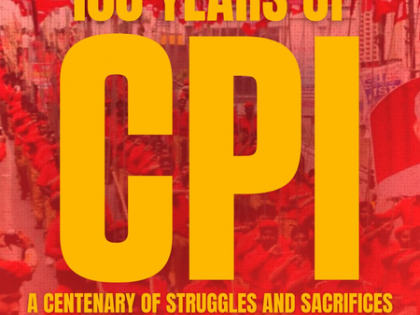
CPI@100: A party of firsts, fractures and a long search for relevance
New Delhi/Thiruvananthapuram, Dec 26 The Communist Party of India (CPI) marks its centenary on December 26, tracing its origins to the founding conference held in Kanpur in 1925.
Centenary celebrations are underway in New Delhi, where General Secretary D. Raja will hoist the party flag at Ajay Bhavan. The programme includes a seminar titled “100 Years of the CPI -- Tradition and the Future”, cultural events, and an exhibition chronicling the party’s long political journey.
Few political formations in India can claim a legacy as consequential as the CPI’s formative years. The party etched its name in global political history in 1957 when E.M.S. Namboothiripad led the world’s first democratically elected communist government in Kerala. The moment placed the CPI at the forefront of parliamentary Left politics, blending ideology with electoral legitimacy.
That trajectory, however, altered sharply after the ideological split of 1964, which led to the formation of the CPI(M). In Kerala, the CPI(M) steadily surged ahead to emerge as the dominant Left force, while the CPI struggled to retain its organisational depth and political influence.
Despite this, the CPI continued to play a significant role in Kerala’s power politics through shifting alliances. Under C. Achutha Menon, the party joined hands with the Congress to form governments in 1969 and again in 1970. It was part of the A.K. Antony-led Cabinet in 1977, and in 1979, P.K. Vasudevan Nair briefly headed a CPI-led ministry before resigning amid political instability.
A decisive turn came in 1980, when the CPI severed ties with the Congress and aligned firmly with the Left Democratic Front (LDF), emerging as its second-largest constituent -- a position it retains to this day. The party is currently part of the ruling LDF in Kerala, holding four Cabinet berths and the Deputy Speaker’s post, and remains in power in Tamil Nadu as a constituent of the DMK-led alliance.
Nationally, however, the CPI’s footprint has steadily contracted. As of 2025, it has two MPs each in the Lok Sabha and the Rajya Sabha, around 20 MLAs across three states, and a marginal presence in Legislative Councils. Recognised as a state party only in Kerala, Tamil Nadu, and Manipur, the CPI enters its second century diminished in scale, yet still grappling with the question of political relevance in a transformed and fragmented Left landscape.
Disclaimer: This post has been auto-published from an agency feed without any modifications to the text and has not been reviewed by an editor
Open in app