
Despite stature, pay, perks at exchequer’s expense, some MPs still prefer drama over delivery
By IANS | Updated: December 1, 2025 17:30 IST2025-12-01T17:27:12+5:302025-12-01T17:30:16+5:30


New Delhi, Dec 1 Instead of participating in legislative business, Opposition Benches in the Lok Sabha tried to ...
Despite stature, pay, perks at exchequer’s expense, some MPs still prefer drama over delivery
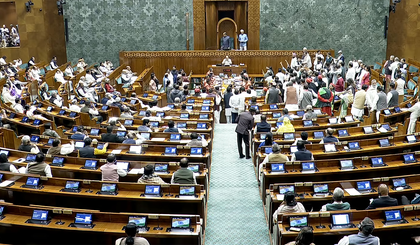
New Delhi, Dec 1 Instead of participating in legislative business, Opposition Benches in the Lok Sabha tried to disrupt the proceeding, raising slogans and delaying the agenda that curtailed a debate on the day Parliament’s Winter Session commenced on Monday.
Such conduct has a direct fiscal consequence where running the Parliament costs an estimated Rs. 2.5 lakh per minute. That translates into about Rs.1.5 crore per hour for both Lok Sabha and Rajya Sabha, or roughly Rs.75 lakh per hour per House.
The Winter Session began on Monday, December 1, and is scheduled to end on December 19. This session will comprise a total of 15 sittings, which although labelled by the Opposition as a “short session”, failed to elicit their response in turning it into something meaningful and effective with active participation.
The response was rather curtailing the allotted period further. Beyond such drama, the real casualty is governance, where laws and public policy that require uninterrupted time and attention, are delayed.
On the first day of the current Winter Session of Parliament, Opposition lawmakers were seen raising their pitch on an issue that is already being perused in the highest court of the land.
Incidentally, before the session commenced, a Trinamool Congress delegation had met the Election Commissioners end-November and aired their grievances which were reportedly addressed by the poll body.
Earlier, too, the Election Commission had agreed to meet any political delegation that sought to clear the air over the Special Intensive Revision (SIR) of electoral rolls currently underway after a gap of over two decades (last conducted 2002-2004).
Monday’s first adjournment came minutes after commencement – immediately after paying tributes to five former Parliamentarians who passed away recently – and another when it reassembled at noon.
Finally, the House had to be adjourned for the day amid repeated disruptions from Opposition Benches.
However, the government introduced the Manipur Goods and Services Tax (Second Amendment) Bill, 2025, which was passed with a voice vote.
Despite the efforts at disruption on the first day itself, as Prime Minister said before the commencement of the current session, “India has proven that Democracy can deliver”.
The Prime Minister used the customary pre-Session media briefing to frame the Winter Session as a test of democratic responsibility and to urge the Opposition to engage constructively, while signalling the government’s legislative priorities and seeking to set the political narrative.
However, the ruckus robbed the citizens of a chance to witness what could have been a lively and informative debate for which a three-hour discussion period had already been granted.
Such chaos comes despite an MP receiving a salary of Rs.1,24,000 per month, after a 24 per cent raise two years back after considering inflation and rising living costs since the last 2018 revision. Additionally, MPs are also given several perks and allowances. These include an allowance of Rs.2,500 per day when they attend a Session, a constituency allowance every month of Rs.87,000, office expenses amounting to Rs.70,000 every month, including paying for staff and stationery.
They are also allocated rent-free housing in central Delhi according to terms served, or as per official designation. They can also avail travel benefits for 24 domestic air journeys (free) each year and all first-class train travels across India.
They also enjoy free medical care for themselves and their family. Then there are allowances for phone and Internet usage, travel allowance, and free units of electricity and water up to a certain level annually.
Despite the stature they enjoy, and pay and perks at the cost of the exchequer, some MPs still prefer drama over delivery in terms of official duties and effective delivery at their constituencies.
Disclaimer: This post has been auto-published from an agency feed without any modifications to the text and has not been reviewed by an editor
Open in app