
Germany sees India as key partner in trade, defence
By IANS | Updated: January 14, 2026 13:55 IST2026-01-14T13:50:24+5:302026-01-14T13:55:08+5:30


New Delhi, Jan 14 Germany’s Chancellor Friedrich Merz has used his first official visit to India to signal ...
Germany sees India as key partner in trade, defence
New Delhi, Jan 14 Germany’s Chancellor Friedrich Merz has used his first official visit to India to signal that Berlin now sees New Delhi as a central partner for trade, technology and security in an increasingly fractured world order. Spread over two days in Ahmedabad and Bengaluru, the visit combined high symbolism with a dense agenda on defence, green transition, mobility and a long‑pending India–EU trade deal, according to an article in India Narrative.
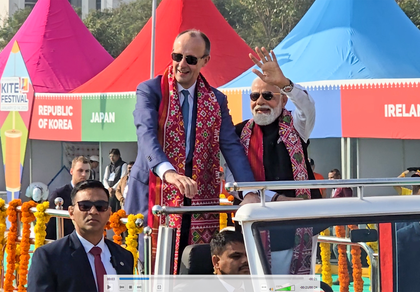
Prime Minister Narendra Modi received Merz in Ahmedabad, where the programme blended political signalling with cultural outreach. Bilateral talks and press statements at Gandhinagar’s Mahatma Mandir provided the formal backdrop for announcements on trade, defence and technology.
The article highlights that economics was the central pillar of the visit, with Merz accompanied by a high‑powered delegation of 23 German CEOs and industry leaders. Both leaders noted that Germany already accounts for over a quarter of India’s trade with the EU and that bilateral trade has hit record highs since 2024, strengthening the case for a more ambitious agenda.
Merz sent a clear signal of the political backing the long‑pending India–EU Free Trade Agreement, as he observed that the deal could be concluded by the end of January. New Delhi and Berlin also welcomed a new Joint Declaration of Intent to strengthen economic cooperation through a German‑Indian CEO Forum, pitched as a permanent channel to deepen investment, technology partnerships and resilient supply chains.
Security and defence industry cooperation received unusually prominent attention for a German leader’s India visit. Modi and Merz backed expanded military‑to‑military engagement through joint exercises and senior‑level exchanges, and endorsed a new roadmap for defence‑industrial cooperation focused on long‑term technology partnerships and co‑development of equipment in India, the article states.
The two countries held discussions on a multi‑billion‑euro project to jointly build submarines in India, aligning Germany’s defence export push with India’s Make in India and Atmanirbhar Bharat priorities. Beyond defence, the two sides signed or exchanged 19 MoUs and eight major announcements across clean energy, digital technology and innovation, framed as tools to advance green and sustainable development.
People‑centric measures were another notable highlight, with India publicly welcoming Germany’s decision to allow visa‑free transit for Indian passport holders, expected to ease travel and business connectivity via German hubs. New agreements on higher education, skilling, renewable‑energy training, sports cooperation, maritime heritage and youth exchanges were showcased as investments in the next generation of the partnership, the article added.
Disclaimer: This post has been auto-published from an agency feed without any modifications to the text and has not been reviewed by an editor
Open in app