
IANS Year Ender 2025: Tribal politics shapes Tripura as BJP consolidates indigenous base
By IANS | Updated: December 30, 2025 17:10 IST2025-12-30T17:05:09+5:302025-12-30T17:10:15+5:30


Agartala, Dec 30 Tribal politics, which has traditionally played a decisive role in Tripura’s electoral process, continued to ...
IANS Year Ender 2025: Tribal politics shapes Tripura as BJP consolidates indigenous base
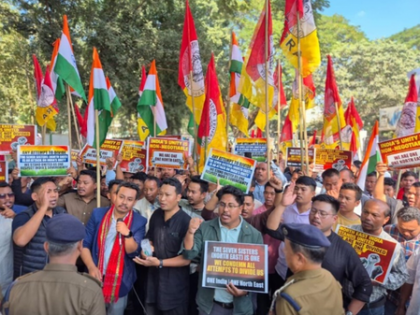
Agartala, Dec 30 Tribal politics, which has traditionally played a decisive role in Tripura’s electoral process, continued to shape the state’s political landscape in the outgoing year, with the ruling BJP focusing on consolidating its organisational base among indigenous communities while gradually reducing its dependence on tribal-based allies, particularly the Tipra Motha Party (TMP).
Ahead of early next year’s elections to the Tripura Tribal Areas Autonomous District Council (TTAADC), the most important constitutional body after the Tripura Legislative Assembly, tribal-based politics has intensified across the state.
Since 2021, the TMP has been governing the politically significant 30-member TTAADC, which covers nearly two-thirds of Tripura’s 10,491 sq km geographical area and is home to over 12.16 lakh people, about 84 per cent of whom belong to indigenous communities.
In the run-up to the TTAADC polls, all major political parties, including the ruling BJP, its allies TMP and the Indigenous People’s Front of Tripura (IPFT), and opposition CPI (M) and Congress, have intensified efforts to consolidate their support among tribals, who constitute nearly one-third of Tripura's 4.2 million population.
To lessen its reliance on tribal-based parties -- TMP and IPFT -- the BJP has, since early this year, stepped up organisational activities in tribal-dominated areas. Both TMP and IPFT are currently allies of the BJP.
As part of this strategy, the BJP on July 17 organised a key meeting titled 'Janajati Chintan Shivir', bringing together elected representatives and organisational leaders from indigenous communities.
Chief Minister Manik Saha, state BJP president Rajib Bhattacharjee, Tribal Welfare Minister Bikash Debbarma, former MP Rebati Tripura, all tribal MLAs, TTAADC members, and other tribal leaders attended the day-long conclave.
Senior tribal leader and BJP state general secretary Bipin Debbarma claimed that around 14,000 people, mostly from indigenous communities, had joined the BJP over the past three to four months.
However, as the BJP intensified public outreach programmes, tensions escalated between the party and its ally TMP. BJP leaders alleged that TMP workers attacked BJP karyakartas (functionaries) in several areas.
"At least 23 BJP karyakartas were injured in more than 10 attacks by TMP activists across different districts," Debbarma told IANS.
In one of the major incidents on July 27, at least seven BJP Janajati Morcha members were seriously injured when TMP supporters allegedly attacked them at Asharambari in Khowai district while they were gathered at a residence to listen to Prime Minister Narendra Modi’s monthly radio programme ‘Mann Ki Baat’.
Similar incidents were reported later at Takarjala in Sepahijala district and other parts of the state, resulting in injuries to several BJP workers.
Meanwhile, the TMP, Congress and CPI (M) also claimed that several thousand people had joined their respective parties during the year.
After prolonged negotiations, the tribal-based TMP, then in the opposition, signed a tripartite agreement with the Centre and the Tripura government on March 2 last year (2024) in the presence of Home Minister Amit Shah.
Subsequently, the party, which has 13 MLAs, joined the BJP-led coalition government on March 7, adding a new dimension to the state's political dynamics.
Two TMP MLAs -- Animesh Debbarma and Brishaketu Debbarma -- were inducted into the Chief Minister Manik Saha-led ministry.
Despite being part of the government, the TMP, led by Pradyot Bikram Manikya Debbarma, continued to press its demands, organising demonstrations in Delhi on September 9 and staging a series of agitations in Tripura.
The party has been demanding ‘Greater Tipraland’, a separate state for tribals under Articles 2 and 3 of the Constitution, early conduct of the long-pending Village Committee elections in TTAADC areas, deportation of illegal migrants, implementation of the Inner Line Permit (ILP), and execution of the tripartite agreement.
Amid what observers describe as a “sweet-and-sour” relationship between the BJP and TMP, the opposition Congress announced its willingness to support all “legitimate demands” of the tribal-based party if it withdrew from the ruling coalition.
The TMP, however, did not respond to the appeal.
Pradyot Bikram Manikya Debbarma, a former state Congress President, had quit the party in September 2019, primarily over differences related to filing a petition in the Supreme Court seeking implementation of the National Register of Citizens (NRC) in Tripura to safeguard indigenous rights.
In a surprising political turn, Chief Minister Manik Saha launched sharp attacks on the BJP’s ally TMP, warning that politics based on blackmail and threats would no longer be tolerated in Tripura.
Addressing a party programme at Baijal Bari in Khowai district last week, CM Saha asserted that no force could prevent the BJP from working in tribal areas.
“Our guardians are Prime Minister Narendra Modi, BJP national president J.P. Nadda and Union Home Minister Amit Shah. We believe in dialogue and peace, not unrest. Law and order will be maintained strictly through constitutional means,” the Chief Minister had said.
Referring to TMP’s demands, CM Saha remarked, “First it was Tipraland, then Greater Tipraland, and now One Northeast. Anyone can raise demands, but they must follow democratic processes.”
He also highlighted increased budgetary allocations and infrastructure development in TTAADC areas under the BJP government.
On the Kokborok language script issue, Saha accused parties of hypocrisy, saying earlier committees had discussed multiple script options but failed to reach a decision.
“Now they selectively raise the issue to create confusion and provoke people,” he alleged.
Citing examples of the BJP’s tribal affinity, the Chief Minister said that seven eminent personalities -- mostly tribal scholars and artists -- from Tripura received Padma Shri awards, while senior tribal leader Jishnu Dev Varma was appointed Governor of Telangana.
Developments in neighbouring Bangladesh also impacted Tripura.
Political turmoil and violence there triggered heightened security along the international border, with the Border Security Force (BSF) intensifying vigil since June–July last year, particularly after the fall of the Sheikh Hasina-led Awami League government on August 5, 2024.
Reports of attacks on minorities, especially Hindus, in Bangladesh prompted widespread protests across Tripura by political parties, civil society and non-government organisations.
In a major boost to religious tourism, Prime Minister Narendra Modi on September 22 inaugurated the redeveloped 524-year-old Mata Tripura Sundari temple at Udaipur, 54 km south of Agartala.
The redevelopment, carried out under the PRASHAD (Pilgrimage Rejuvenation and Spiritual Heritage Augmentation Drive) scheme at a cost of over Rs 54 crore, enhanced facilities at one of the 51 Hindu Shakti Peethas.
Additionally, replicas of all 51 Shakti Peethas are being constructed at the under-construction 51 Shakti Peethas Park at Banduar in Gomati district at a cost of Rs 97.70 crore.
The original 51 Shakti Peethas are spread across various states in India and also in Pakistan, Nepal and Bangladesh.
Chief Minister Manik Saha laid the foundation stone for the park project on July 13.
Like other northeastern states, Tripura intensified its "war against drugs" during the year.
The Tripura Police, in coordination with central forces and intelligence agencies, including Assam Rifles, seized narcotics worth over Rs 500 crore -- mostly smuggled from Myanmar -- and arrested around 200 drug peddlers.
Chief Minister Saha, who also holds the Home portfolio, reiterated the government's zero-tolerance policy towards drugs, stating that the administration remains committed to securing a drug-free future for Tripura’s youth.
Disclaimer: This post has been auto-published from an agency feed without any modifications to the text and has not been reviewed by an editor
Open in app