
Rising Questions Over Aviation Safety!
By Vijay Darda | Updated: February 3, 2026 07:10 IST2026-02-03T07:08:32+5:302026-02-03T07:10:35+5:30



Many people have been lost before, and now Ajit Dada is gone. Do we learn any lessons from such tragedies?
Rising Questions Over Aviation Safety!
In India, we make many claims about aviation safety. But whenever a plane mishap occurs, it raises a plethora of questions over flight safety standards.
We have lost Maharashtra’s dynamic leader Ajit Dada. What remains are his memories. During the last Assembly session in Nagpur, I hosted a dinner in honour of Maharashtra ministers and legislators, which was attended by Dada also. He greeted me with remarkable warmth and cheer. Usually a serious man, Ajit Dada had a rare sparkle in his eyes that day and a visible joy radiated from his presence. He told me that my son Parth would soon be moving into the same building where I live. “I’ll come to see the house,” he said. “Then we’ll sit together, eat and chat at length.” I replied jokingly, “Dada, there will be no fighting, only celebrations.”
Who can understand what destiny has in store? The story remained unfinished before it could fully unfold. Dada became part of a rainbow of memories. Those who depart never return. Only memories remain. He learned the lessons of politics by following in the footsteps of his political mentor and uncle Sharadchandra Pawar. The only difference being, Sharadchandra Pawar practiced politics with a smile, while Ajit Dada was forthright and blunt. His yes always meant yes and no meant no. Like Pawar Saheb, Ajit Dada’s day would begin at dawn. His first meeting would start at 7 am! Many such qualities made him admirable. No matter how important an event in Mumbai might be on a Saturday or Sunday, he would not attend, as one day was reserved for Pune and the other for Baramati.
I have many memories of Dada, but at this moment I cannot shake off one troubling thought: Why is air travel becoming so unsafe? We all claim that aviation safety in India has improved significantly, and we have plenty of paperwork and statistics to support this. In global aviation safety rankings, we have climbed from 112th to 55th place. Yet the question remains: Where are we failing? On the road, even in case of severe accidents, there is still a chance of survival. But in the air, even the smallest error can mean death for every passenger on board. There are countless rules and regulations for VIP movement in India, still how do such lapses occur? How many people have we lost in such accidents? The list is long -- Homi Bhabha, Gen Bipin Rawat, Sanjay Gandhi, Madhavrao Scindia, Vijay Rupani, O P Jindal, G M C Balayogi, Y S Rajasekhara Reddy, Dorjee Khandu and Cyprian Sangma, among many others. Incidentally, during the 1965 war, the aircraft carrying Gujarat’s then chief minister Balwantrai Mehta was shot down by Pakistan, mistaking it for a military aircraft, but that was a different matter altogether. I am speaking here of those we lost in accidents. On the other hand, there is also a long list of leaders -- from Vasantrao Naik to Devendra Fadnavis -- who narrowly escaped mishaps mid-air.
When Rahul Gandhi was on an election tour in Andhra Pradesh, I noticed that while landing, such a massive cloud of dust rose that the helicopter was not visible at all. The sight terrified me. Let me recount another incident. My younger brother Rajendra Darda and I were travelling by helicopter from Mumbai to Thane -- a journey of barely 10 to 15 minutes. But the fog was so dense and the pollution so severe that nothing was visible. That route has many hills and tall buildings. We completed the journey praying to God. Almost every day, we hear reports of some aircraft suffering bird hits or a dog wandering onto the runway. Several pilots have complained that even laser beams have caused them serious trouble during flights.
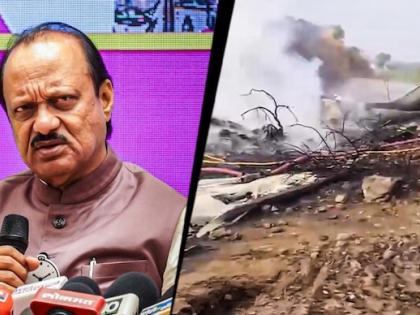
Now, the details emerging about the crash of Ajit Dada’s chartered aircraft are shocking. It is being reported that the aircraft itself had technical problems. Moreover, Baramati airport has neither an air traffic control system nor an instrument landing system. Radio communication is handled by instructors from a local flight training school. The pilot had to look directly towards the Sun to locate the runway. The glare of the Sun may well have caused disorientation. And the second, most crucial issue that has come to light is the pilot Captain Sumit Kapoor’s ‘fondness’ for alcohol. On two occasions, he was found intoxicated before flights, and the DGCA had suspended him for three years. The question is, why was such a pilot entrusted with flying an aircraft? In commercial aviation, strict checks are conducted to ensure that a pilot has had at least seven hours of sleep and is not under the influence of alcohol. But are these rules enforced just as strictly in the case of chartered aircraft and helicopters?
If even the smallest airports lack adequate safety arrangements, why are they being operated at all? Even if an airport receives only one aircraft every month or two, its safety standards should be no different from those of major airports. While all states must ensure proper safety at their airports, a developed state like Maharashtra should set an example. Ajit Dada is gone. No one can bring him back. But we must at least ensure that such air accidents never happen again and that no more lives are lost.
Ajit Dada… we will never forget you. Farewell!
The author is the chairman, Editorial Board of Lokmat Media and former member of Rajya Sabha.
