
India poised to become 2nd country after Russia to operate fast breeder reactor
By IANS | Updated: April 27, 2026 18:20 IST2026-04-27T18:16:52+5:302026-04-27T18:20:31+5:30



New Delhi, April 27 India is poised to become the second country after Russia to operate a commercial-level ...
India poised to become 2nd country after Russia to operate fast breeder reactor
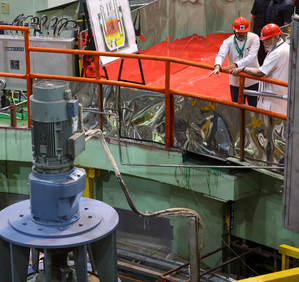
New Delhi, April 27 India is poised to become the second country after Russia to operate a commercial-level fast breeder reactor as the indigenously designed 500 MWe Prototype Fast Breeder Reactor (PFBR) at Kalpakkam in Tamil Nadu achieved first criticality on April 6, Union Minister Jitendra Singh said on Monday.
Addressing a workshop of MPs and MLAs on "Small Modular Reactors", the minister said, this reactor, developed by the Indira Gandhi Centre for Atomic Research (IGCAR) and built by BHAVINI, marks the start of the second stage of India's three-stage nuclear power programme, using uranium-plutonium mixed oxide fuel to produce more fuel than it consumes. With this achievement, India moves toward leveraging its vast thorium reserves in the third stage of its nuclear strategy.
Once fully operational, India will be the second country in the world, after Russia, to be operating a commercial-level fast breeder reactor, he added.
Dr Singh said that the significance of this achievement lies in the fact that with this, India moves toward leveraging its vast thorium reserves in the third stage of its nuclear strategy.
Currently, Russia is the only country operating commercial fast breeder reactors (FBRs), with India in the advanced stage of commissioning its own. While several nations have historically developed or operated experimental fast reactors, specifically the US, the UK, France, Japan, Germany, and China, most of these programmes are currently shut down.
Referring to recent developments in India’s three-stage nuclear programme, Dr Singh said that the successful establishment of the Prototype Fast Breeder Reactor marks a significant step towards the second stage of the programme, enabling more efficient utilisation of nuclear fuel and paving the way for future use of India’s vast thorium reserves.
The Minister further stated that nuclear energy will play a crucial role in India’s clean energy transition and long-term sustainability goals, particularly in achieving the target of 100 GW nuclear power capacity by 2047.
Highlighting emerging requirements, Singh said that sectors such as Artificial Intelligence, data infrastructure and advanced manufacturing will increasingly depend on reliable and continuous sources of clean energy, where nuclear power will be indispensable.
The minister also underlined the importance of initiatives such as Small Modular Reactors (SMRs), policy support, and the SHANTI Act, enabling greater participation of the private sector in scaling up India’s nuclear energy capacity. He said, under the recently launched "Nuclear Mission”, with an allocation of Rs 20,000 crore, five SMRs are planned by 2033.
The minister further stated that SMRs will be useful for captive power generation, particularly in Industry, dense population zones, remote areas lacking grid connection, repurposing thermal plants etc.
A balanced energy mix, combining nuclear, renewable and other clean energy sources, will be key to achieving the goal of Net Zero by 2070, he added.
Disclaimer: This post has been auto-published from an agency feed without any modifications to the text and has not been reviewed by an editor
Open in app