
Risk of US-Venezuela direct confrontation rises as Maduro defies Trump’s blockade
By IANS | Updated: December 18, 2025 08:45 IST2025-12-18T08:42:59+5:302025-12-18T08:45:10+5:30



New York, Dec 18 Defying US President Donald Trump’s blockade of Venezuela, its President Nicolas Maduro has ordered ...
Risk of US-Venezuela direct confrontation rises as Maduro defies Trump’s blockade
New York, Dec 18 Defying US President Donald Trump’s blockade of Venezuela, its President Nicolas Maduro has ordered his navy to escort oil tankers, raising concerns over the risk of a military confrontation.
Media reports of the escorts for Venezuelan tankers on Wednesday followed Trump’s announcement on Tuesday that he had assembled “the largest Armada ever assembled in the History of South America” to enforce the blockade.
In a Truth Social post, he declared Maduro’s administration a terrorist organisation, derecognising it as a legitimate government in his view to try to legitimise his action.
Venezuela is reported to have the biggest oil reserves in the world, but its political instability and corruption, combined with opposition to the West, have prevented it from exploiting its resources.
As fears of a naval confrontation between Trump’s armada and Maduro’s navy mounted, attempts were underway internationally and in the US to defuse the situation.
Two resolutions in the US House of Representatives to prevent an escalation of the standoff by requiring Congressional approval failed narrowly on Wednesday.
"We have a president beating the drums of war without so much as a vote from the House of Representatives,” said Democrat Jim McGovern, who moved one of the resolutions.
The UN Security Council’s President, Slovenia, said that it has received a letter from Venezuela regarding the US actions and is consulting the members of the Council.
Maduro called UN Secretary-General Antonio Guterres to discuss the situation.
The UN said that Guterres “reaffirmed the United Nations position on the need for Member States to respect international law, particularly the United Nations Charter, exert restraint and de-escalate tensions to preserve regional stability”.
Mexico’s President Claudia Sheinbaum said the UN “must assume its role to prevent any bloodshed and to always seek the peaceful resolution of conflicts”.
Trump had narrowed the impact of his blockade to “ghost” ships that are already under sanctions and operate surreptitiously, leaving open the possibility of other ships operating unhindered for now.
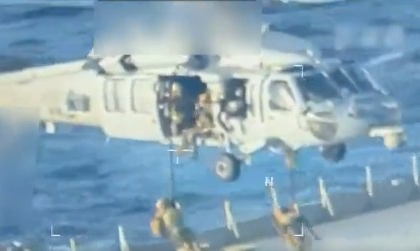
One of the “ghost” ships, the 'Skipper', was seized last week on high seas by the US Coast Guard, making it a civil action as that force is not part of the military and falls under Attorney General Pam Bondi’s jurisdiction.
The ship was reportedly on its way to Cuba when Coast Guards rappelled down from helicopters and took control of it.
The tankers sailing out on Wednesday were reportedly headed to Asia and were not a part of the “ghost” fleet targeted by Trump.
But China, one of Venezuela’s biggest customers, accused the US of “bullying”.
China’s Foreign Minister Wang Yi said, “China believes the international community understands and supports Venezuela’s position in defending its legitimate rights and interests”.
Trump has committed himself to seeing Maduro, who was accused of engineering his re-election last year through fraud, out of power.
He has accused the country of endangering the security of the US through its drug exports and by sending over criminals from its prisons.
The confrontation started in September when Trump ordered a campaign against boats allegedly transporting drugs to the US.
So far, about 25 boats have been bombed, and about 80 people have been killed.
Disclaimer: This post has been auto-published from an agency feed without any modifications to the text and has not been reviewed by an editor
Open in app