
India's Indus Reset: From treaty restraint to strategic leverage after Pahalgam terror attack
By ANI | Updated: April 25, 2026 16:35 IST2026-04-25T22:01:36+5:302026-04-25T16:35:09+5:30



Chandigarh [India], April 25 : India's suspension of the Indus Waters Treaty (IWT) following the 2025 Pahalgam terror attack ...
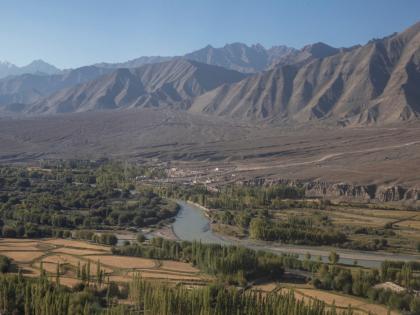
India's Indus Reset: From treaty restraint to strategic leverage after Pahalgam terror attack
Chandigarh [India], April 25 : India's suspension of the Indus Waters Treaty (IWT) following the 2025 Pahalgam terror attack has reignited debate over water security, sovereignty, and long-term strategic planning, with a recent analysis in Saviours Magazine arguing that New Delhi must convert the move into a lasting hydrological and geopolitical advantage.
In a strongly worded article, former bureaucrat KBS Sindhu describes the 1960 treaty as "an act of remarkable and ultimately imprudent generosity", suggesting that India conceded a disproportionate share of river waters to Pakistan under outdated assumptions of goodwill.
Writing in Saviours Magazine, Sindhu said the agreement was based on expectations that Pakistan would adhere to "the norms of civilised inter-state relations", an assumption he argues has "not survived intact".
The Indus Waters Treaty, brokered by the World Bank and signed by Prime Minister Jawaharlal Nehru and Pakistan's President Ayub Khan, allocated the eastern rivers Ravi, Beas and Sutlej to India while granting Pakistan control over the larger western rivers Indus, Jhelum and Chenab.
According to Sindhu's analysis in Saviours Magazine, this division resulted in Pakistan receiving nearly 80 percent of the basin's total water flow.
"The arithmetic was staggering in its imbalance," Sindhu wrote, adding that India, despite being the upper riparian state, "willingly constrained itself" while Pakistan benefited downstream.
The article comes in the backdrop of India placing the treaty "in abeyance" after the April 22, 2025 Pahalgam terror attack, in which 26 civilians were killed.
Sindhu argues that the move is both legally defensible and strategically overdue. Quoting principles of international law, he said a "fundamental change of circumstances" including decades of cross-border terrorism justifies suspension of treaty obligations.
"India is under no enforceable compulsion, in law or in conscience, to maintain a water compact that subsidises the agricultural economy of a state that exports terror," Sindhu said in his analysis published in Saviours Magazine.
Beyond legal arguments, the article highlights India's underutilisation of its own water entitlements. Projects such as the Ranjit Sagar Dam and Shahpur Kandi Dam faced decades of delays, allowing significant volumes of water to flow into Pakistan unused.
Sindhu noted that "each year of delay has allowed roughly 0.6 MAF of India's own Ravi entitlement to flow unhindered across the border," even as groundwater levels in Punjab continue to decline.
On the western rivers, where the treaty permits limited storage and hydropower development, India has also fallen short. Sindhu points out that while the country is allowed to build up to 3.6 million acre-feet of storage, only a fraction has been realised. Similarly, hydropower potential of over 18 gigawatts remains largely untapped.
"Pakistan... weaponised the treaty's dispute architecture," Sindhu said, alleging that repeated objections and arbitration proceedings have delayed Indian infrastructure projects.
The Saviours Magazine article also places India's decision in a broader global context, arguing that international norms are increasingly shaped by national interest rather than legal frameworks. Sindhu cited examples of major powers disregarding treaties when strategic priorities shift, suggesting that India's approach is consistent with evolving global behaviour.
"The lesson is unambiguous: nations, when sufficiently pressed, subordinate treaty text to sovereign survival," he wrote.
A key focus of the analysis is the strategic importance of water for India's internal stability, particularly in Punjab. The state relies heavily on groundwater, with extraction far exceeding recharge rates. Sindhu warned that declining water tables pose not just an agricultural challenge but a national security risk.
"A depleted Punjab... is an invitation to instability," he said, linking water scarcity to economic distress and potential social unrest in a sensitive border region.
To address this, Sindhu proposed a series of large-scale infrastructure projects aimed at diverting water from the western rivers to northern Indian states.
Among them is the proposed Chenab-Ravi diversion through the Marhu Tunnel, which he described as capable of transforming "a diplomatic signal into a hydrological reality".
He also advocated for accelerated construction of major storage dams such as Bursar and Sawalkot, as well as inter-basin transfer systems connecting the Jhelum and Beas rivers. These projects, he argued in Saviours Magazine, should be treated as national security priorities with full central funding and fast-tracked clearances.
"Threatening what one cannot yet deliver is a confession of weakness," Sindhu cautioned, emphasising that India's leverage will depend on actual infrastructure rather than political rhetoric.
The article further suggests that water could eventually become a bargaining tool in India-Pakistan relations. As Pakistan faces growing water stress due to population pressures and climate change, Sindhu believes it may be compelled to negotiate.
"When Pakistan eventually comes to the table... it will come not as an equal partner... but as a state in a water crisis," he said, adding that any future agreement should be linked to verifiable action against terrorism.
Institutional reforms are another major theme of the analysis. Sindhu called for the creation of a National Indus Basin Authority to oversee planning and execution of projects, along with legislative backing to streamline approvals and reduce bureaucratic delays.
In conclusion, Sindhu framed the suspension of the Indus Waters Treaty not as an end in itself but as the beginning of a broader strategic shift. "What comes next is not about revenge or headlines," he wrote in Saviours Magazine. "It is about transforming a political signal into a hydrological fact, and a hydrological fact into a strategic reality."
As India recalibrates its approach to water sharing with Pakistan, the debate outlined in Saviours Magazine underscores the complex intersection of security, sustainability, and sovereignty that will shape the future of the Indus basin.
Disclaimer: This post has been auto-published from an agency feed without any modifications to the text and has not been reviewed by an editor
Open in app