
MEA Secretary outlines massive industry shift in India-Korea maritime pact
By ANI | Updated: April 20, 2026 21:25 IST2026-04-21T02:50:19+5:302026-04-20T21:25:13+5:30



New Delhi [India], April 20 : India and South Korea have moved to deepen cooperation in shipbuilding, shipping, and ...
MEA Secretary outlines massive industry shift in India-Korea maritime pact
New Delhi [India], April 20 : India and South Korea have moved to deepen cooperation in shipbuilding, shipping, and maritime logistics as part of a broader comprehensive framework being advanced during the South Korean President's ongoing visit to India, aimed at strengthening strategic and economic ties between the two Indo-Pacific partners.
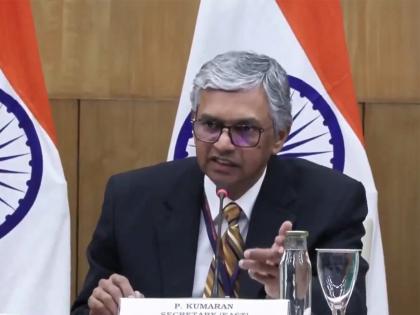
Providing a technical blueprint for the "new voyage" between India and South Korea, Ministry of External Affairs (MEA) Secretary (East) P Kumaran revealed that the partnership has moved into a high-gear industrial phase.
The collaboration, he noted, is shifting from high-level diplomacy to granular, long-term capacity building aimed at revolutionising India's shipbuilding and port infrastructure.
Secretary Kumaran highlighted that the private sector is already anchoring these diplomatic goals. A significant milestone in this effort is a non-binding Memorandum of Understanding (MOU) involving HD Korea Shipbuilding & Offshore Engineering (HD KSOE), and domestic stakeholders.
He said, "Several initiatives have been taken as part of this at the level of industries too. One includes a non-binding MOU between the Korean shipbuilder HD Korea Shipbuilding & Offshore Engineering (HD KSOE), the identified cluster developer and facilitator."
This partnership is designed to move beyond traditional trade, focusing instead on the infusion of advanced technology and the modernisation of existing infrastructure.
He added, "Overall, the emphasis is on upgrading existing shipyards, including developing block fabrication facilities and setting up a new dry dock to construct large and specialised vessels."
The Secretary detailed a comprehensive plan to upgrade the physical capabilities of Indian shipyards to handle global-scale projects.
He said, "We are also looking at financing and skill training... There will also be cooperation in developing port infrastructure, knowledge sharing, training our workers, and financing will be another area where the maritime development fund and the Korean sites development partnership funds would be used for advancing this programme. We are also looking at jointly designing manufacturing and supporting next-generation conventional and autonomous maritime and port cranes."
To ensure the partnership remains sustainable over the coming decades, Kumaran emphasised a dual focus on human capital and capital markets.
"If economic cooperation is like a ship, then financing and skills are the engines that keep it running," the Secretary suggested, outlining two primary funding streams, the Maritime Development Fund (India) and the Korean Sites Development Partnership Funds.
These funds will be utilised to facilitate knowledge sharing and intensive skill training for Indian workers, ensuring the workforce can maintain and operate the next generation of maritime technology.
By combining Korean engineering prowess with Indian labour and strategic location, the MEA envisions a self-sustaining ecosystem.
The Secretary concluded that the focus remains on "upgrading the existing shipbuilding ecosystem" to ensure India becomes a competitive global hub for maritime manufacturing and autonomous port operations.
The framework comes at a time when both countries are seeking to diversify and secure critical maritime supply chains amid shifting global trade dynamics. India has been actively pushing for the expansion and modernisation of its shipbuilding capacity under its broader maritime development vision, while South Korea remains one of the world's leading shipbuilding nations with advanced technological capabilities.
The ongoing high-level visit by the South Korean leadership is expected to further accelerate discussions on investment flows, technology transfer, and joint manufacturing opportunities.
Officials on both sides view the maritime partnership as a key pillar in expanding the India-South Korea special strategic relationship, with potential spillover benefits in port-led industrial development and blue economy growth.
With multiple institutional and private-sector linkages now being explored, the collaboration signals a more structured and long-term maritime partnership between New Delhi and Seoul.
Disclaimer: This post has been auto-published from an agency feed without any modifications to the text and has not been reviewed by an editor
Open in app