
Priyanka Gandhi Condemns Khamenei’s Killing as ‘Despicable’, Urges Global Leaders to Choose Peace Over War
By Lokmat Times Desk | Updated: March 1, 2026 17:07 IST2026-03-01T17:06:45+5:302026-03-01T17:07:30+5:30



Senior Congress leader Priyanka Gandhi Vadra has strongly condemned the reported killing of Ayatollah Ali Khamenei amid the rapidly ...
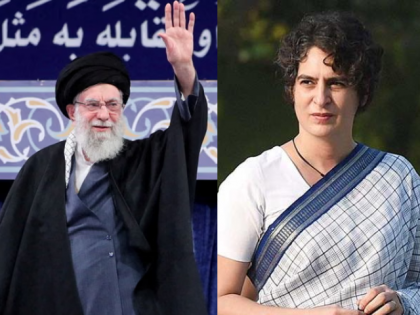
Priyanka Gandhi Condemns Khamenei’s Killing as ‘Despicable’, Urges Global Leaders to Choose Peace Over War
Senior Congress leader Priyanka Gandhi Vadra has strongly condemned the reported killing of Ayatollah Ali Khamenei amid the rapidly escalating conflict in West Asia, calling it a “targeted assassination of the leadership of a sovereign nation.” In a sharply worded post on X, she described the act and the large-scale loss of innocent lives as “despicable” and said such actions deserve unequivocal condemnation, irrespective of the reasons put forward to justify them. She warned that the situation has drawn multiple countries into the confrontation, raising serious concerns about regional stability and the possibility of a broader war.
Taking to X, the Congress leader posted, "The targetted assassination of the leadership of a sovereign nation by the so called leaders of the democratic world and the killing of multitudes of innocent people is despicable and deserves strong condemnation, no matter what the proclaimed reason for it is. It is tragic that multiple nations have now been dragged into conflict. The world needs peace not more unnecessary wars. Those in charge of it would do well to remember Mahatma Gandhi’s words: An eye for an eye makes the whole world blind. I do hope that having genuflected before the Prime Minister of Israel and President Trump, our Prime Minister makes every effort to bring all Indian citizens in the affected countries back home to safety."
The targetted assassination of the leadership of a sovereign nation by the so called leaders of the democratic world and the killing of multitudes of innocent people is despicable and deserves strong condemnation, no matter what the proclaimed reason for it is.
— Priyanka Gandhi Vadra (@priyankagandhi) March 1, 2026
It is tragic that…
Check Live Updates Here: US-Iran War LIVE Updates: 4 Marines Injured After Iran Attack on Oil Tanker in the Strait of Hormuz
The Iranian Embassy in New Delhi lowered its flag to half-mast on Sunday after Iran’s Supreme Leader, Ayatollah Ali Khamenei, was killed in coordinated strikes reportedly carried out by the United States and Israel a day earlier. According to Iranian state media, several members of his family — including his daughter, grandchild, daughter-in-law and son-in-law — were also among those killed. The incident is being described as one of the most significant and dramatic escalations in West Asia in recent years, triggering widespread shock and strong reactions across diplomatic and political circles.
The strikes, reportedly executed under the code names Operation Epic Fury and Lion’s Roar, were aimed at locations linked to Iran’s top leadership. In response, Iran launched a barrage of missiles and drones targeting Israel and U.S. military installations in the region, sharply escalating hostilities and deepening fears of a wider conflict. The exchange of attacks has further destabilised an already volatile region, with global powers closely monitoring developments amid concerns of prolonged military confrontation and its potential international repercussions.
Following Khamenei’s death, Iran has announced 40 days of national mourning, Reuters reported citing state media. In Shia Islam, the 40th day after a person’s death, known as Arba'een, holds profound religious and cultural importance. Flags across the country have been lowered to half-mast, while memorial services and public gatherings are being organised in tribute to the late leader. The extended mourning period is also expected to allow the clerical leadership time to oversee a sensitive transition of power amid heightened geopolitical uncertainty.
Khamenei assumed leadership in 1989 after succeeding Ruhollah Khomeini, the founder of the Islamic Republic. Over 37 years, he shaped Iran’s domestic and foreign policy with a firm stance against Western influence, strengthened clerical authority, and adopted an assertive regional strategy. His death signals the conclusion of a defining era in Iran’s contemporary history, ushering in a period marked by national grief, political transition and intensified regional tensions.
Open in app